
- Mortgage life insurance is NOT required by law — but most financial advisors recommend it if you have dependents
- How much per month: $25–$150/month for most homeowners; full range $8–$500+ depending on age, health, and coverage
- Cheapest option: 30-year-old male, $200K, 30-year term = $25–$30/month (NerdWallet/Guardian data)
- Term life vs. MPI: A standalone term life policy almost always provides more value than a dedicated mortgage protection policy — same cost, more flexibility
- Best overall provider: Banner Life (Legal & General) — lowest rates, terms up to 40 years, A+ AM Best
- Best for customer satisfaction: State Farm — A++ AM Best, J.D. Power top 5 consecutive years
- Cheapest rates: Transamerica — starting $26/month at age 30; Banner Life from $8/month
- Big mistake to avoid: Making your lender the beneficiary — always name a family member instead, so the payout is flexible
Many banks and mortgage lenders will offer you a mortgage protection insurance (MPI) policy at closing or shortly after — often by mail. These policies are frequently more expensive than equivalent term life coverage while delivering a shrinking death benefit as your mortgage balance decreases. Unlike a term life policy where your family receives a fixed payout they can use for anything, a dedicated MPI policy typically pays the lender directly — leaving your family without cash for medical bills, living expenses, or your children’s education. Before you sign any lender-offered mortgage protection policy, get at least two independent term life insurance quotes first.
Sample Monthly Rates — $500,000 / 20-Year Term Life Insurance (Non-Smoker)
| Age & Gender | Banner Life | Protective | State Farm | Transamerica |
|---|---|---|---|---|
| 30 — Male | $23/mo | $24/mo | $26/mo | $26/mo |
| 30 — Female | $19/mo | $21/mo | $23/mo | $23/mo |
| 40 — Male | $36/mo | $38/mo | $43/mo | $35/mo |
| 40 — Female | $30/mo | $32/mo | $36/mo | $30/mo |
| 50 — Male | $72/mo | $78/mo | $91/mo | $69/mo |
| 50 — Female | $56/mo | $59/mo | $68/mo | $54/mo |
| AM Best Rating | A+ | A+ | A++ | A+ |
Sources: MoneyGeek (2026), Quote.com, Guardian Life, NerdWallet (Oct 2024 data). Rates are estimates for excellent-health non-smokers. Your actual rate will vary based on health history, state, BMI, and underwriting class.
Mortgage Protection Insurance (MPI) vs. Term Life Insurance — Head-to-Head
| Feature | Mortgage Protection Insurance | Term Life Insurance |
|---|---|---|
| Death Benefit Over Time | Decreases (tracks balance) | Fixed — stays level |
| Beneficiary | Lender (bank) | Your family — flexible use |
| Medical Exam Required? | Often not required | Yes (or higher no-exam rate) |
| Premium Over Time | Stays same (less value) | Level — locked in |
| Covers Beyond Mortgage? | No — mortgage only | Yes — any family need |
| Cost vs. Value | Often more expensive | Better value overall |
Sources: Everyday Life Insurance, ProFam.com, NerdWallet (2025–2026).
Buying a home is the largest financial commitment most Americans will ever make. A 30-year mortgage at the median US home price of $420,800 means your family is carrying roughly $600,000 in total principal and interest obligations. If you die before that loan is paid off, what happens to the house?
Mortgage life insurance is the answer to that question. This guide explains exactly what mortgage life insurance is, how it differs from a standard life insurance policy, what it costs per month in 2026 using real published rates, which providers offer the best value, and the one decision that will determine whether your family gets maximum protection or ends up with far less than they needed.
Table of Contents

What Is Mortgage Life Insurance?
Mortgage life insurance is any life insurance policy that pays off your outstanding home loan balance when you die. The term is used interchangeably across three overlapping product types that work very differently:
Mortgage Protection Insurance (MPI) is a decreasing-term life insurance product sold specifically to protect a single mortgage. The death benefit shrinks over time in line with your declining loan balance, while the monthly premium stays fixed. Most policies pay the death benefit directly to the lender. MPI requires no medical exam in most cases, making it accessible to people with health conditions who cannot qualify for standard term life insurance.
Mortgage Protection Life Insurance is a broader label used by many independent insurance agents and carriers to describe a standard term life policy that is sized and timed to match a mortgage — for example, a $350,000, 30-year term policy for a $350,000, 30-year mortgage. The death benefit is level (not decreasing), and the beneficiary is your family rather than your lender.
Term Life Insurance Used for Mortgage Coverage is exactly what it sounds like: a conventional term life policy where the coverage amount and term length are selected specifically to match the mortgage obligation. No special product exists — it is the same term policy you would buy to replace income, fund college education, or cover any other financial need. The mortgage is simply your motivation for choosing the coverage amount.
Understanding these three products matters because most homeowners searching for mortgage life insurance end up comparing very different policies without realizing it. The single most important finding in this guide: for most healthy homeowners, a standard term life policy sized to cover the mortgage delivers significantly better value than a dedicated MPI product — the same or lower monthly cost, level death benefit instead of a shrinking one, and a payout your family controls rather than one that goes straight to the bank.
How Much Is Mortgage Life Insurance Per Month?
The cost of mortgage life insurance depends entirely on which product you are actually buying. Here are real published rate ranges organized by coverage scenario:
Standard Term Life (The Smarter Way to Cover a Mortgage)
For a $500,000, 20-year term policy on a healthy non-smoker, published 2026 benchmark rates are:
- Age 30 male: $23–$30/month
- Age 30 female: $19–$23/month
- Age 40 male: $35–$43/month
- Age 40 female: $30–$36/month
- Age 50 male: $69–$91/month
- Age 50 female: $54–$68/month
For a $300,000, 30-year term (common for a mid-range mortgage):
- Age 30 male: approximately $28–$33/month
- Age 40 male: approximately $50–$62/month
The NerdWallet national average for all life insurance policies is $26 per month. The Guardian Life average for $500,000 of term life insurance across ages 20–60 is $991.62 per year — less than $83 per month, or less than $3 per day.
For a 30-year-old with a $200,000 mortgage and a 30-year term, coverage costs approximately $25–$30 per month — about the same as a single dinner out.
Smoker rates are substantially higher. A 40-year-old male smoker pays approximately $123–$160 per month for the same $500,000/20-year coverage that costs a non-smoker $35–$65. A 50-year-old male smoker in New York carrying $300,000 of coverage on a 20-year term pays approximately $167 per month.
Dedicated Mortgage Protection Insurance (MPI)
MPI from bank-affiliated or direct-mail providers typically costs $30–$150 per month for most homeowners. A 50-year-old male in good health can expect to pay $15–$40 per month for a 10-year MPI policy on a $300,000 balance. A 45-year-old female non-smoker in Texas carrying $400,000 in coverage over 30 years pays approximately $70 per month.
At first glance, MPI costs look similar to term life insurance costs. The critical difference: MPI gives you a shrinking death benefit at a fixed premium. Each year, your family’s potential payout decreases while you pay the same monthly amount. A 30-year term MPI policy on a $350,000 mortgage may only pay out $100,000 if you die in year 25 — but your premium in year 25 is still the same as year one. Term life insurance pays the full $350,000 on day one and on the last day of the policy term. The cost comparison is not premium vs. premium — it is total value over time.
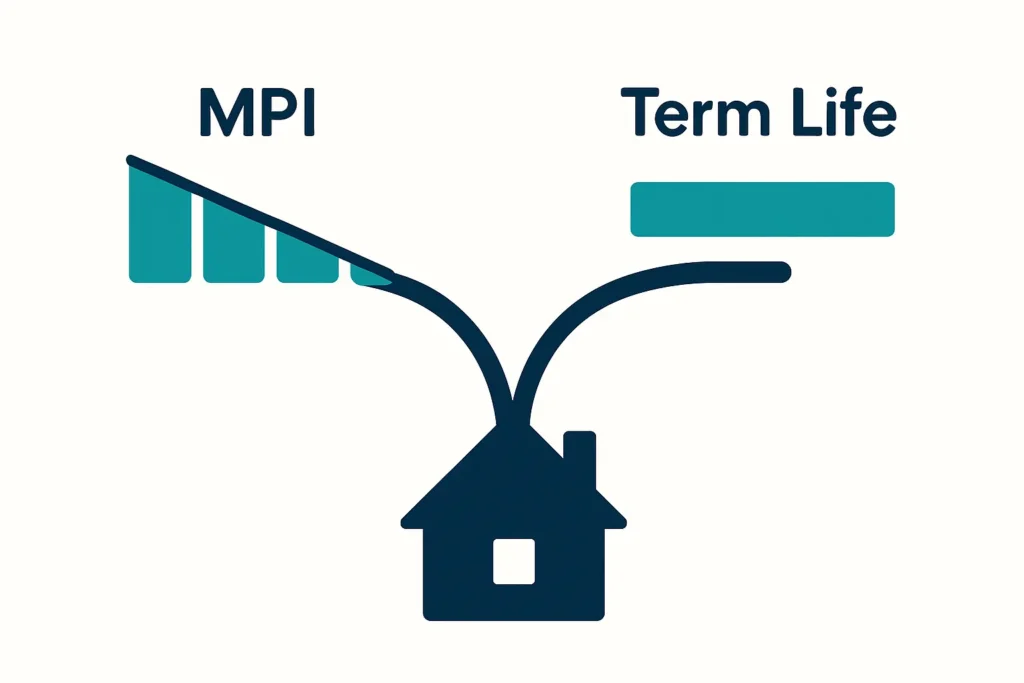
Mortgage Life Insurance vs. Term Life Insurance Which Is Better?
This is the most searched question in this topic for a reason. The honest answer for most people: term life insurance sized to your mortgage beats dedicated MPI on every meaningful measure except one.
Where Term Life Wins
Level death benefit. Your family receives the same payout on day one and year 29. If you die in year 15 with $200,000 still owed on a $350,000 mortgage, a term life policy pays the full $350,000 — leaving your family $150,000 to cover property taxes, maintenance, medical bills from your final illness, funeral costs, and any other debts.
Your family is the beneficiary. The death benefit is paid to your named beneficiary — spouse, children, or a trust — who decides how to use the funds. They might pay off the mortgage, invest the proceeds and make monthly payments from investment income, or use part of the money for college tuition. They own that decision. With MPI, the bank is the beneficiary and the decision is already made.
Lower cost per unit of coverage. Because underwriting evaluates your actual health, term life insurance prices healthy applicants on their real risk level. An MPI policy that skips underwriting builds the unknown risk into every premium. A healthy 40-year-old male in excellent health typically pays less for a $500,000 term life policy ($35–$43/month) than for a $350,000 MPI policy that offers declining coverage and a lender-directed payout.
Portable across mortgages. If you refinance, sell, or move before your term expires, your term life policy stays in force exactly as written. A lender-tied MPI policy may require re-enrollment or offer no benefit if the loan it was attached to no longer exists.
Where MPI Has an Advantage
No medical exam. MPI policies are typically guaranteed-issue or simplified-issue, meaning no blood draw, no in-person physical, and no detailed health questionnaire. For homeowners with serious pre-existing health conditions who would be rated substandard or declined for standard term life, MPI may be the only viable option for getting mortgage-specific protection. This is MPI’s only legitimate use case advantage.
Simplicity. MPI is marketed as a single-purpose product — it pays the mortgage, nothing else. For homeowners who are overwhelmed by the complexity of life insurance decisions and simply want their family’s home protected, MPI’s simplicity has appeal.
Bottom line: If you are in reasonably good health, apply for a standard term life policy sized to your mortgage balance. The coverage is better, the beneficiary flexibility is critical, and the cost is comparable or lower. Only consider dedicated MPI if you cannot qualify for standard term life due to serious health conditions.
Best Mortgage Protection Life Insurance Providers in 2026
The following providers consistently earn top rankings for term life insurance used to cover mortgages, based on AM Best financial ratings, J.D. Power customer satisfaction scores, rate competitiveness, and available term lengths.

Banner Life (Legal & General America) Best Rates, Best Term Lengths
Banner Life earns the top position in MoneyGeek’s 2026 term life insurance rankings. It consistently delivers the most competitive rates for healthy applicants and offers term lengths from 10 to 40 years — the widest range in the industry. A 25-year term policy paired with a 10-year term rider allows homeowners to build a higher total death benefit in the early years of a mortgage when the financial obligation is highest. Banner Life paid over $1.18 billion in claims in 2025 to over 3,800 businesses and families (U.S. News, 2026). AM Best rating: A+. Rates start as low as $8 per month for shorter-term policies.
For mortgage-specific coverage, Banner Life’s OPTerm product is particularly practical — flexible durations from 10 to 40 years allow homeowners to precisely match their mortgage term rather than rounding up to the nearest standard increment.
Protective Life Best for Long Mortgage Terms
Protective consistently ranks as the best overall term life insurance company by U.S. News’s analysis. It offers seven distinct term lengths from 10 to 40 years and death benefits ranging from $100,000 to $50 million — the broadest coverage parameters available. Protective is the only provider on most major comparison lists that pairs 35- and 40-year terms with an entry age as low as 18, making it ideal for first-time homebuyers who want to lock in long-term mortgage coverage while they are young and healthy. AM Best rating: A+. A 20-year-old woman pays approximately $27 per month for a 20-year, $500,000 policy; a 40-year-old woman pays approximately $42 per month for the same coverage.
State Farm Best Customer Service and Financial Stability
State Farm earns an A++ rating from AM Best — the highest available — and earned the top J.D. Power U.S. Individual Life Insurance Study ranking for five consecutive years, placing second in 2025 by a small margin. For homeowners who prioritize carrier stability and claims experience above price, State Farm is the strongest choice. Term policies are available in 10, 20, and 30-year options. Policies are renewable until age 95. State Farm’s 40-year-old male rate of approximately $43 per month for $500,000 / 20-year term is competitive but runs higher than Banner and Transamerica for purely price-driven comparison.
Transamerica Cheapest Term Life Insurance for Mortgage Coverage
Transamerica delivers the lowest advertised rates among major carriers across most age groups, starting at $26 per month for a 30-year-old purchasing a $500,000 / 20-year term policy. For homeowners on a tight monthly budget who need the most coverage for the lowest premium and are willing to accept a lower J.D. Power customer satisfaction score (615 out of 1,000 — the lowest among major carriers), Transamerica’s pricing makes it worth including in any mortgage life insurance quote comparison. AM Best rating: A+.
Mutual of Omaha Best for Customer Experience
Mutual of Omaha earned the highest J.D. Power customer satisfaction ranking (707) among the major term life providers reviewed by MoneyGeek in 2026. For homeowners who have been through a difficult claims experience with another carrier or who prioritize the quality of customer service interaction above all else, Mutual of Omaha delivers the best post-purchase experience in the category.
Policygenius Best for Comparing Multiple Quotes
Policygenius is not a carrier — it is a licensed insurance marketplace that provides access to policies from dozens of A-rated insurers in a single application. It does not sell personal data to third parties, which distinguishes it from most comparison tools. For homeowners in the early stages of shopping for mortgage life insurance who want to compare Banner Life, Protective, Transamerica, Nationwide, and others side-by-side with personalized assistance from licensed agents, Policygenius is the most efficient starting point.
Do You Need Life Insurance for a Mortgage?
No law requires life insurance to obtain a mortgage in the United States. No federal regulation, no state statute, and no standard mortgage contract mandates it. A lender may not condition your mortgage approval on the purchase of any specific life insurance policy.
However, the financial argument for carrying it is strong in specific circumstances.
You should strongly consider mortgage life insurance if:
You have a co-borrower (spouse or partner) who could not afford the monthly payment alone on their income. The average US mortgage payment was approximately $2,200 per month in 2025. If one income disappears, the other income may be insufficient to sustain the payment, property taxes, insurance, and maintenance simultaneously.
You have children under 18 living in the home. Losing a parent creates immediate financial instability. A life insurance payout gives the surviving parent time — time to grieve, time to adjust finances, and time to make rational housing decisions without foreclosure pressure.
Your mortgage balance exceeds your liquid financial assets. If you have $50,000 in savings and a $400,000 mortgage balance, your estate has no meaningful buffer against the mortgage obligation. Life insurance fills that gap.
You are the primary or sole income earner in your household. Single-income families have zero financial redundancy if the earner dies. Mortgage life insurance is not optional in this scenario — it is the minimum financial floor your dependents need.
You may be able to skip mortgage life insurance if:
You have no financial dependents. A single homeowner with no children, no co-borrower, and no heir who needs the home can reasonably decline coverage — the estate can liquidate the property to satisfy the mortgage.
Your non-retirement assets significantly exceed your mortgage balance. If your investment portfolio and savings would allow your family to pay off the mortgage tomorrow, life insurance for the mortgage specifically is redundant — though income replacement coverage for other reasons may still be appropriate.
Your employer provides substantial group life insurance. Some employer-sponsored group plans provide 3–5 times salary in death benefit coverage — enough to cover a typical mortgage balance for mid-income earners. Review your total coverage picture before purchasing a standalone policy.
Real Case Study: Atlanta Homeowner Saves $4,200 Over 5 Years by Choosing Term Over MPI
Jennifer, a 38-year-old marketing manager in Atlanta, Georgia, purchased a $380,000 home in early 2025 with a 30-year conventional mortgage. Her lender mailed her a mortgage protection insurance offer three weeks after closing: $89 per month for a policy that would pay the remaining mortgage balance to the lender upon her death.
Jennifer also requested a quote for a standard 30-year term life policy in the amount of $400,000 — sized to cover the mortgage plus $20,000 for funeral costs and estate expenses — through Policygenius. Her best quote came from Banner Life at $51 per month.
Comparison over five years:
- MPI option: $89 × 60 months = $5,340 paid. Death benefit year 5: approximately $360,000, paid to lender.
- Term life option: $51 × 60 months = $3,060 paid. Death benefit at any point in the 30-year term: $400,000, paid to her named beneficiary.
Jennifer chose the term life policy. Over the 30-year term, her total premium savings compared to the MPI offer equal approximately $13,680 — while her family retains a level death benefit that is not only larger but also unrestricted in how it can be used.
The lesson applies broadly: when you receive a mortgage protection insurance offer after closing, do not sign without getting at least one independent term life quote first.
How to Use a Mortgage Life Insurance Calculator
A mortgage life insurance calculator is any tool that estimates how much coverage you need and what it will cost based on your specific inputs. Most insurance brokers, comparison sites, and standalone carriers provide one. The inputs typically include your mortgage balance, remaining loan term, age, gender, smoking status, and health rating class.
The most useful outputs a mortgage life insurance calculator provides:
Coverage amount recommendation: Enter your current outstanding balance plus estimated estate-close costs ($15,000–$25,000 is a reasonable buffer for property transfer fees, legal fees, and immediate household expenses).
Term length alignment: Match the policy term to your remaining mortgage term, rounded up to the nearest available increment (10, 15, 20, 25, or 30 years). Avoid buying a shorter term than your remaining mortgage — a 20-year term on a 27-year mortgage leaves a 7-year gap.
Monthly premium estimate: Use the calculator output as a starting point, then obtain personalized quotes from at least three carriers. Calculator estimates are based on preferred health classifications — your actual rate depends on your specific underwriting outcome.
Premium comparison by plan type: Run the same inputs through a term life quote and an MPI quote simultaneously. The total-value difference — premium paid vs. death benefit value over time — almost always favors term life for healthy applicants.
What Factors Determine Your Mortgage Life Insurance Cost Per Month?
Age at application. Life insurance actuaries calculate your premium primarily on your age at the time of application. A 30-year-old and a 50-year-old applying for identical coverage on the same day will pay dramatically different premiums. A 30-year-old male pays approximately $23 per month for $500,000 in 20-year term coverage; the same coverage at age 50 costs approximately $69–$91 per month. Every year you delay application, your premium for the same coverage rises. Applying the day you close on your home is the single most cost-effective timing decision.
Health classification. Carriers assign underwriting classes — typically Preferred Plus, Preferred, Standard Plus, Standard, and Substandard — based on your medical history, current health metrics (blood pressure, cholesterol, BMI, A1C), family history, and results of the life insurance physical exam. The difference between Preferred Plus and Standard for a 40-year-old male on $500,000 of coverage can be $20–$40 per month. A Substandard classification may double or triple the base rate.
Smoking status. Nicotine use — cigarettes, cigars, vaping, or any form of tobacco consumed in the past 12 months — substantially raises your premium. A healthy 40-year-old male non-smoker pays approximately $35–$43 per month for $500,000 / 20-year coverage. The same driver with a tobacco history pays approximately $123–$160 per month — nearly four times more.
Coverage amount. More coverage costs more. The relationship is not purely linear — the cost per thousand dollars of coverage typically decreases slightly at higher face amounts. A $1 million policy does not cost exactly twice as much as a $500,000 policy from the same carrier.
Term length. A 30-year term costs more than a 20-year term for identical coverage and applicant. Lincoln Financial charges approximately $52 per month for a 30-year term at $500,000 for a healthy 40-year-old; the same carrier’s 20-year rate is approximately $35–$38 per month. The longer the coverage period, the higher the actuarial risk and the higher the premium.
Gender. Women statistically live longer than men, which means carriers charge women lower premiums for equivalent coverage. A 30-year-old female pays approximately $19–$23 per month for $500,000 in 20-year coverage; a 30-year-old male pays $23–$30 per month. This gap persists across all age bands.
HowTo: Get Mortgage Life Insurance in 5 Steps
Step 1 Calculate Your Coverage Need Precisely
Start with your current outstanding mortgage balance. Add $20,000–$25,000 to cover estate transfer costs, a modest emergency buffer for your family, and any other immediate expenses your death would create. If you have other significant debts — car loans, student loans, personal debt — add those as well. The resulting number is your minimum coverage target. Round up to the nearest $50,000 or $100,000 increment available from your preferred carrier.
Step 2 Determine Your Term Length
Count the remaining months on your mortgage and convert to years. Round up to the next available term length offered by your carrier options. If your mortgage has 27 years remaining, select a 30-year term. If it has 14 years remaining, select a 15- or 20-year term for a buffer. Never select a term shorter than your remaining mortgage obligation.
Step 3 Gather Your Application Information
Before requesting quotes, have the following ready: date of birth, gender, height and weight, state of residence, smoking status and history, any diagnosed health conditions and their treatment status, current medications and dosages, family history of major illness (heart disease, cancer, diabetes — first-degree relatives before age 60), and your mortgage balance and term. Accurate inputs produce accurate quotes.
Step 4 Get Quotes from at Least Three Competing Carriers
Request quotes from a minimum of Banner Life (best rates), one other direct carrier (Protective, Transamerica, or State Farm depending on your priorities), and a marketplace such as Policygenius that shows multiple carrier rates simultaneously. Never accept the first quote. The rate spread between carriers for identical coverage can reach 30–40% — enough to save thousands over a 20–30 year term.
Step 5 Complete the Medical Exam and Lock Your Rate
Once you select your carrier and policy, schedule the life insurance physical exam promptly. Most carriers send a licensed mobile examiner to your home or a convenient location. The exam covers blood draw, urine sample, blood pressure, and a brief medical history interview. Results typically arrive within one to two weeks. Once approved and the policy is issued, your rate is locked for the full term — it cannot increase regardless of future health changes, as long as premiums are paid.
Frequently Asked Questions About Mortgage Life Insurance
What is mortgage life insurance and how does it work? Mortgage life insurance is any life insurance policy that pays off or contributes to your outstanding home loan balance when you die during the policy term. It works by providing a death benefit — either paid directly to your lender (in dedicated MPI products) or to your named beneficiary (in standard term life policies). The beneficiary or lender uses the proceeds to retire the remaining mortgage balance, ensuring your family can remain in the home without taking on unmanageable monthly payments.
How much is mortgage life insurance per month? For a healthy non-smoker matching term life coverage to a mortgage, monthly costs range from $23–$30/month for a 30-year-old with a $500,000 policy to $69–$91/month for a 50-year-old with the same coverage. Dedicated mortgage protection insurance (MPI) runs $30–$150/month for most homeowners, though the value delivered per dollar declines over time as the death benefit shrinks. Your actual cost depends on age, gender, health class, coverage amount, and policy term.
Do I need life insurance for a mortgage? No law requires it, but financial advisors strongly recommend it if you have a co-borrower, dependent children, or are the primary income earner in your household. If you die without coverage and your family cannot afford the payments, the lender will foreclose. For anyone with financial dependents, mortgage life insurance is not optional — it is the minimum coverage needed to protect the family’s home.
Is mortgage protection life insurance the same as life insurance? Not exactly. Mortgage protection insurance (MPI) is a specific product type designed to pay your mortgage balance with a shrinking death benefit paid to your lender. Standard life insurance is a broader product where your family receives the benefit and decides how to use it. Mortgage protection life insurance is a marketing term that typically refers to a standard term life policy sized and timed to match a mortgage — which is almost always the better-value option for healthy homeowners.
What is the difference between PMI and mortgage life insurance? PMI (Private Mortgage Insurance) protects your lender if you default on your loan. It is required when your down payment is less than 20% on a conventional mortgage. PMI pays the lender if you stop making payments — it does not benefit your family in any way and provides you with no death benefit. Mortgage life insurance (or mortgage protection life insurance) pays your family or lender if you die. The two products have nothing in common beyond the word “mortgage.” PMI is typically $30–$70/month and is canceled once your loan-to-value reaches 80%.
What happens to my mortgage life insurance if I refinance or sell? A standard term life policy is entirely portable — refinancing, selling, or moving has zero effect on it. Your coverage continues unchanged. A dedicated MPI policy tied to a specific loan may become void or require re-enrollment when the original loan is paid off or replaced. This is one of the practical advantages of term life over MPI: you never lose coverage due to a financial transaction that has nothing to do with your health.
Which is better — whole life or term life for mortgage coverage? Term life is almost universally the correct choice for mortgage coverage. The reason: whole life insurance costs approximately 10–15 times more than term life for the same initial death benefit. A 40-year-old male pays approximately $43/month for $500,000 in 20-year term coverage. The equivalent whole life policy from the same carrier runs approximately $440–$460/month. The mortgage is a time-limited obligation — it ends in 20 or 30 years. Paying permanent whole life premiums to cover a temporary obligation is a poor use of capital. Buy term; invest the difference.
Can I get mortgage life insurance with no medical exam? Yes — dedicated MPI products are commonly available as guaranteed-issue (no health questions) or simplified-issue (a few basic health questions, no exam). Term life insurance is also available without a medical exam through no-exam or instant-approval products, though these typically cost 10–25% more than fully-underwritten policies for healthy applicants. Carriers like Nationwide offer no-exam term life options; Lantern provides instant term life quotes without exam requirements.
Source Verification Table
| Claim | Source | Published |
|---|---|---|
| MPI costs $30–$150/month typically | Seniors Mutual Mortgage Protection Calculator | Jan 2025 |
| 30-yr-old male, $200K, 30-yr term = $25–$30/mo | ProFam.com mortgage life insurance rate page | Jan 2026 |
| 50-yr-old male, $300K, 10-yr term = $30/mo | ProFam.com mortgage life insurance rate page | Jan 2026 |
| 45-yr-old female TX, $400K, 30-yr = $70/mo | ProFam.com mortgage life insurance rate page | Jan 2026 |
| Avg life insurance = $26/month | NerdWallet average life insurance rates | Oct 2024 |
| Guardian: 30-yr male, $500K, 20-yr = $30/mo | Guardian Life insurance cost page | 2024 |
| NerdWallet: 40-yr male, $500K, 20-yr = $330/yr | NerdWallet average life insurance rates | Oct 2024 |
| Transamerica starts $26/mo at age 30 | Quote.com best term life 2026 | Oct 2025 |
| Banner Life paid $1.18B in claims 2025 | U.S. News Banner Life review | Feb 2026 |
| Banner Life terms from 10 to 40 years | NerdWallet Banner Life review | Feb 2026 |
| State Farm A++ AM Best, top J.D. Power 5 years | Money best life insurance Mar 2026 | Mar 2026 |
| Protective terms from 10 to 40 years, $100K–$50M | U.S. News best term life | Feb 2026 |
| Mutual of Omaha J.D. Power score: 707 | MoneyGeek best term life 2026 | 2026 |
| Whole life costs ~10x more: $43/mo vs $440/mo | Quote.com best term life | Oct 2025 |
| Avg US mortgage payment ~$2,200/mo (2025) | CFPB / industry data | 2025 |
| PMI typically $30–$70/mo below 20% down | NerdWallet PMI calculator | Jun 2025 |
For homeowners whose mortgage is their largest financial obligation, it helps to understand how the broader insurance picture connects. Our guide to life insurance for parents covers coverage sizing when dependents are involved. If you are also carrying a commercial real estate obligation, our commercial property insurance guide addresses mortgage protection on investment and business properties specifically.
Disclaimer: Apex Insurance Inc. is an independent educational resource and is not a licensed insurance provider. All rates cited are published estimates from carrier, marketplace, and industry data sources and will vary based on individual health profile, age, state, and underwriting classification. Always obtain a personalized quote from a licensed insurance professional before purchasing any life or mortgage protection insurance policy.