
- Average monthly cost: $113–$400/month depending on coverage bundle
- Cheapest entry point: FLIP general liability starts at $25.92/month
- Full bundle (BOP + commercial auto + workers’ comp) runs $250–$400/month
- Required by law: Commercial auto insurance in nearly every US state
- Required for permits: Most cities and festivals demand $1M–$2M general liability proof
- Best overall provider: ERGO NEXT (GL from $73/mo); best for fleets: The Hartford
- Don’t skip: Equipment breakdown + food spoilage — one weekend refrigeration failure can cost $1,000–$3,000 in lost inventory
If you drive your food truck to an event and cause an accident, your personal auto policy will deny the claim outright. The same applies to your cooking equipment, product liability, and employee injuries. Operating a commercial food truck without dedicated commercial insurance exposes you to six-figure personal liability, permit revocation, and license suspension. This is not optional coverage — it is the legal foundation your business must have before serving a single customer.
| Coverage Type | Avg Monthly Cost | Cheapest Option | Required? |
|---|---|---|---|
| Commercial Auto | $170/mo | Progressive | Yes — Law |
| General Liability | $42–$141/mo | FLIP $25.92 | Permit Req. |
| BOP (GL + Property + Interruption) | $85–$207/mo | ERGO NEXT $112 | Recommended |
| Workers’ Compensation | $43–$78/mo | ERGO NEXT $43 | Req. w/ staff |
| Equipment Breakdown | $15–$35/mo | BOP Add-on | Optional |
| Food Spoilage Coverage | $10–$20/mo | Endorsement | Optional |
| Liquor Liability | $58/mo | Insureon $58 | If serving alcohol |
| Full Bundle Estimate | $250–$400/mo | $3,000–$5,000/yr | Best Value |
Sources: Insureon (2024), MoneyGeek (2026), PolicyOwl/Insureopedia (2025). Rates vary by state, truck value, menu type, and claims history.
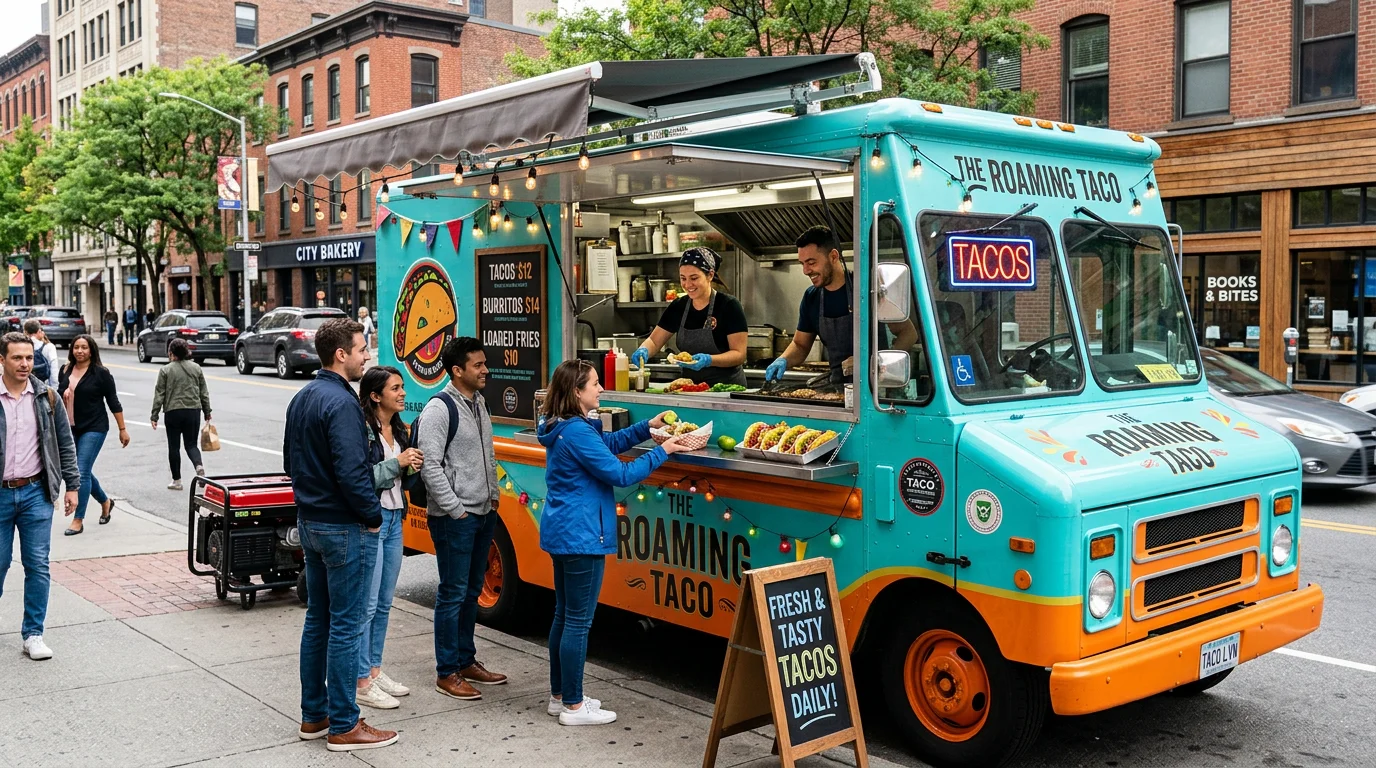
You built a food truck to serve great food — not to become an insurance expert. But the moment your truck hits a public road or opens a service window, commercial food truck insurance stops being optional paperwork and becomes the legal foundation holding your business together.
This guide covers every coverage type you need, what commercial food truck insurance actually costs from real providers in 2026, which policies are legally required, and how a Texas operator cut his annual premium by $1,400 without sacrificing coverage. Whether you are searching for cheap food truck insurance, trying to understand food trailer liability insurance, or comparing the best commercial food truck insurance options on the market, this breakdown gives you the numbers you need to make a smart decision.
Table of Contents
What Is Commercial Food Truck Insurance?
Commercial food truck insurance is a bundle of policies designed specifically for mobile food businesses. It is not a single policy. It is a combination of coverages that address the two distinct risk environments your truck operates in: on the road (commercial auto) and at the service window (general liability, product liability, equipment).
Standard personal auto insurance excludes business use entirely. If you cause an accident while driving your food truck to a festival, your personal insurer will deny the claim. The same exclusion applies to everything inside the truck. Commercial food truck insurance fills every gap that personal coverage leaves open.
The US food truck industry generates over $1.2 billion in annual revenue (IBISWorld, 2025). Cities from Austin to Chicago now require proof of commercial food truck insurance before issuing operating permits. Skipping coverage is not just financially reckless — in most states, it is illegal.
7 Types of Commercial Food Truck Insurance You Need in 2026
1. Commercial Auto Insurance (Legally Required in Almost Every State)
Commercial auto is the non-negotiable foundation of commercial food truck insurance. It covers bodily injury and property damage you cause to others while driving your truck. It also covers physical damage to your own truck through collision and comprehensive endorsements.
Most states require a minimum of $300,000 in commercial auto liability. Food truck operators who finance their vehicles or carry built-in equipment worth more than $10,000 should carry $500,000 to $1,000,000. The average commercial auto policy for food service businesses costs $170 per month according to Insureon’s 2024 data, though Progressive Commercial frequently comes in below that benchmark.
One important distinction: commercial auto only covers permanently attached equipment. If your deep fryer is bolted to the truck floor, it is covered. Your removable prep tables, blenders, and point-of-sale tablets are not. Those fall under commercial property or BOP coverage.
2. General Liability Insurance (Required for Permits and Events)
General liability insurance is the policy that every food truck permit office, festival organizer, and commissary kitchen will ask to see before you can operate. It covers third-party bodily injury, property damage, and advertising injury claims.
Common general liability scenarios for food trucks include: a customer slipping near your service window, a delivery worker injured by your sandwich board, a claim that your marketing infringed on a competitor’s trademark, or fire damage you accidentally cause to a rented event booth space.
Most cities and event venues require at least $1 million per occurrence and $2 million aggregate in general liability before issuing permits. The average monthly cost ranges from $42 per month (Insureon’s commercial food truck insurance data) to $141 per month (MoneyGeek’s broader analysis). FLIP offers commercial food truck insurance general liability starting at $25.92 per month, making it the most affordable entry point for solo operators who already have commercial auto elsewhere.
3. Business Owner’s Policy — BOP (The Smart Bundle)
A Business Owner’s Policy combines general liability, commercial property coverage, and business interruption insurance into one package — almost always cheaper than buying these three coverages separately. Bundling saves food truck operators an estimated 10% to 25% annually according to MoneyGeek’s 2026 analysis.
The property portion of a BOP covers your removable equipment, inventory, and supplies — the stuff that falls out if you flip the truck upside down. Business interruption coverage pays your lost income if a covered event forces you to stop operating: a kitchen fire, a burst generator, a vehicle collision that puts you off the road for three weeks.
Average BOP cost for commercial food truck insurance runs $85 to $207 per month. ERGO NEXT currently offers the most affordable BOP for food truck operators at $112 per month, a 46% reduction from the $207 industry average per MoneyGeek (2026).
4. Workers’ Compensation (Required With Employees in Most States)
If you have one employee working on your truck — even part-time, even a family member — most US states require workers’ compensation insurance. It covers their medical expenses, lost wages, and rehabilitation costs if they are injured on the job. It also protects you from personal lawsuits over workplace injuries.
Workers’ comp for commercial food truck insurance averages $43 to $78 per month depending on your state and employee count. ERGO NEXT offers the cheapest entry point at $43 per month; Insureon’s food truck data puts the average at $78 per month.
California, New York, and Texas have strict workers’ comp enforcement for food businesses. Operating without it while employing staff risks fines, criminal charges, and full personal liability for any on-the-job injury.
5. Equipment Breakdown Coverage
Your commercial food truck runs on equipment worth thousands of dollars: generators, refrigeration units, deep fryers, grills, and point-of-sale systems. When any of these fail mechanically, your commercial auto or general liability policy will not pay for the repair. Equipment breakdown coverage fills that gap.
This coverage is typically available as an endorsement to your BOP for $15 to $35 per month. Given that generator replacement alone can run $2,000 to $5,000, this is one of the highest-return add-ons available in commercial food truck insurance.
6. Food Spoilage Coverage
One extended power outage or a refrigeration failure can destroy $1,000 to $3,000 worth of prepped ingredients — enough to cancel an entire weekend of events. Food spoilage coverage reimburses you for inventory lost due to equipment breakdown or power failure.
It is available as an endorsement to most BOP policies for $10 to $20 per month. If you operate at busy weekend markets, music festivals, or multi-day events, the cost of this endorsement is recovered after a single prevented loss.
7. Liquor Liability Insurance (If You Serve Alcohol)
Food trucks serving craft beer, wine pairings, or specialty cocktails need liquor liability insurance. Most states with dram shop laws hold the business financially responsible for damages caused by intoxicated customers who were served by your staff. Without liquor liability, a single incident can result in a six-figure personal lawsuit.
Liquor liability for food businesses averages $58 per month according to Insureon’s commercial data. You may also need it to obtain a liquor license in many jurisdictions.
How Much Is Food Truck Insurance Monthly? Real Numbers by Coverage Type
These are 2025–2026 averages drawn from Insureon, MoneyGeek, Insureopedia, and FLIP’s published pricing:
General Liability only: $25.92 (FLIP entry) to $141/month average
BOP: $85 to $207/month average; ERGO NEXT $112/month
Commercial Auto: $170/month average
Workers’ Comp: $43 to $78/month
Full Bundle (BOP + auto + workers’ comp): $250 to $400/month, or $3,000 to $5,000 annually
Recommended bundle with all add-ons: $312/month per MoneyGeek’s 2026 composite
A solo food truck operator with no employees, a $40,000 truck, and basic equipment should budget $200 to $280 per month for adequate commercial food truck insurance coverage. Add employees and that climbs to $280 to $400 per month.
Best Commercial Food Truck Insurance Providers in 2026
ERGO NEXT — Best Overall Value
ERGO NEXT earned the top MoneyGeek score of 4.82 out of 5 for food truck business insurance in 2026. It offers the lowest rates across three core coverage types: general liability at $73/month, workers’ comp at $43/month, and BOP at $112/month. Its fully online quoting process and same-day certificate issuance make it the most practical option for operators who need a COI before a weekend event.
The Hartford — Best for Fleets and Professional Liability
The Hartford scores 4.62 out of 5 and earns the top rating for coverage breadth. It offers the cheapest professional liability for food truck operators at $52 per month. Its FleetAhead telematics program helps multi-truck operations reduce premiums over time through driver data monitoring. The Hartford is the strongest choice for commercial food truck auto insurance on fleets of two or more vehicles.
Progressive Commercial — Best for Commercial Auto
Progressive is the largest commercial vehicle insurer in the US by policy count (Insurance Information Institute). For food truck operators, Progressive’s commercial auto quotes frequently beat the $170 monthly average. It also offers straightforward bundling with general liability and easy online quoting in all 50 states.
FLIP (Food Liability Insurance Program) — Best Cheap Food Truck Insurance Entry Point
FLIP’s base commercial food truck insurance policy starts at $25.92 per month. It is a general liability-only product underwritten through Accelerant National. FLIP also offers a food trailer endorsement for $12.50 per month that extends GL coverage to detached food trailers at events. It does not offer commercial auto, so operators must carry a separate auto policy. Ideal for new operators or those with a separate fleet policy.
Insureon — Best for Comparing Multiple Quotes
Insureon is a licensed commercial insurance marketplace, not a direct carrier. It allows food truck operators to compare quotes from multiple A-rated insurers in one application. Insureon’s published averages from real food truck policies show BOP at $84/month and commercial auto at $170/month — useful benchmarks for negotiating with any individual carrier.
Real Case Study: Austin Food Truck Operator Saves $1,400 Annually
Marcus, who operates a barbecue food truck in Austin, Texas, originally purchased separate policies for commercial auto ($220/month), general liability ($180/month), and workers’ comp ($95/month) from three different carriers — totaling $495/month or $5,940 annually.
After a policy review, he switched to ERGO NEXT for a BOP ($112/month) that combined his GL and commercial property, added Progressive Commercial for auto ($168/month), and kept a standalone workers’ comp policy at $43/month through ERGO NEXT. His new total: $323/month, or $3,876 annually. Annual savings: $2,064. He also added food spoilage coverage ($15/month) and equipment breakdown ($22/month), bringing his final monthly premium to $360 — still $135 per month less than his original fragmented coverage.
The lesson: bundling commercial food truck insurance through fewer carriers, rather than purchasing policies piecemeal, consistently delivers the best cost outcome.
What Factors Affect Your Commercial Food Truck Insurance Cost?
Menu type and cooking equipment: Deep fryers and open-flame grills carry significantly higher fire risk than coffee equipment or cold-pressed juice operations. Carriers price accordingly. Operators running high-heat cooking should expect to pay 15% to 30% more for the same coverage limits.
Truck value and equipment: A custom-built truck with $30,000 in permanently installed appliances costs more to insure than a converted van with $8,000 in equipment. Commercial auto physical damage coverage is priced on actual cash value or agreed value.
State and location: Vermont and New Hampshire have the cheapest commercial vehicle insurance in the US (MoneyGeek 2026). Urban markets with dense traffic — New York, Los Angeles, Chicago — carry higher auto premiums.
Claims history: One at-fault accident can raise your commercial food truck auto insurance by 20% to 40%. A three-year claims-free record qualifies for safe driver discounts across most carriers.
Number of employees: Every added employee increases your workers’ comp exposure. Most carriers re-rate workers’ comp annually based on payroll.
Credit score: Most commercial insurers factor business credit into premium calculations. A strong credit profile can reduce your commercial food truck insurance cost by 10% to 20%.
How to Get Cheap Food Truck Insurance Without Cutting Critical Coverage
Bundle everything with one or two carriers. Buying BOP, commercial auto, and workers’ comp from the same insurer — or from connected marketplace insurers — reduces your total by 10% to 25%.
Pay annually. Monthly installment plans add 5% to 11% in processing fees. Paying your annual commercial food truck insurance premium upfront saves $300 to $660 on a $3,000 to $6,000 annual policy.
Raise your deductible. Moving from a $500 to a $1,000 deductible reduces monthly premiums by 10% to 25%. Do not raise it higher than your 30-day cash reserve.
Keep a clean driving record. Commercial auto insurers check all drivers on your policy. One DUI or serious moving violation on your record typically adds $1,200 to $3,000 per year to your food truck commercial auto insurance.
Get at least three competing quotes. NEXT Insurance, The Hartford, and Progressive quote the same coverage very differently based on their individual risk models. Using a marketplace like Insureon or Simply Business lets you compare simultaneously.
Add safety equipment. Fire suppression systems, commercial-grade exhaust hoods, and dash cameras can qualify you for equipment and safety discounts on commercial food truck insurance policies across most major carriers.
Food Trailer Liability Insurance — Is It Different From Food Truck Coverage?
Food trailers — mobile units that are towed rather than driven — require modified coverage compared to a self-propelled food truck. The towing vehicle needs its own commercial auto policy covering the trailer hookup. The trailer itself is covered as equipment under inland marine or a BOP endorsement when detached.
FLIP offers an exclusive food trailer endorsement for $12.50 per month that extends general liability to incidents occurring in, on, or around your detached food trailer at events. This is the only such endorsement currently offered as a standalone product.
When the trailer is attached to and being pulled by a commercial vehicle, it falls under the towing vehicle’s commercial auto policy. When parked and operating independently at a festival, the food trailer endorsement activates. Operators who run both a truck and a trailer need both: commercial auto on the towing vehicle and GL coverage that specifically extends to the detached trailer setup.
Commercial Food Truck Insurance Requirements by State (Key US Markets)
Texas: Commercial auto insurance is mandatory. Workers’ comp is not required by state law but is effectively required for any food truck operating at permitted events or private venues. General liability of $1M minimum is standard for Austin, Houston, and Dallas permit applications.
California: Commercial auto is mandatory. Workers’ comp is required the moment you hire any employee. California also requires carriers to be admitted (not surplus lines) for most small business policies, which affects your carrier options and pricing.
Florida: Commercial auto is mandatory. No-fault personal injury protection (PIP) rules do not apply to commercial vehicles. General liability of $500,000 to $1M is typically required by major event venues in Miami, Tampa, and Orlando.
New York: Commercial auto is mandatory. Workers’ comp and disability insurance are both required with any employees. NYC food truck permits specifically require $1M/$2M general liability on the COI.
Illinois: Commercial auto is mandatory. Chicago’s Mobile Food Dispenser license requires general liability insurance of $1M per occurrence and $2M aggregate — among the strictest requirements in the US.
How To: Get Commercial Food Truck Insurance in 5 Steps
Step 1 — Gather Your Business Information
Before requesting commercial food truck insurance quotes, collect: truck year, make, model, and VIN; current market value of the truck; value of all installed equipment; estimated annual revenue; number of employees; states where you operate; and a list of events or venues where you regularly appear.
Step 2 — Identify Which Coverages Are Required
Check your state’s commercial auto minimum requirements. Check your city or county’s food truck permit application for required liability limits. If you have employees, confirm your state’s workers’ comp mandate. If you serve alcohol, confirm whether your state requires liquor liability for a permit.
Step 3 — Get at Least Three Competing Quotes
Request quotes from at minimum: ERGO NEXT or Insureon (online marketplace), Progressive Commercial (direct for auto), and The Hartford (direct for fleet or specialty coverage). Do not use a general personal auto comparison tool for commercial food truck insurance — the coverage categories do not translate correctly.
Step 4 — Compare the Exclusions, Not Just the Price
Read what is specifically excluded before signing. The four most common commercial food truck insurance exclusions are: off-premises equipment coverage gaps, foodborne illness sublimits, employee dishonesty exclusions, and pollution exclusions that affect generator exhaust or propane incidents. Ask your agent to confirm how each applies.
Step 5 — Bundle, Purchase, and Get Your COI
After selecting your carrier or carriers, purchase your policies and immediately request your Certificate of Insurance. Most festivals, commissary kitchens, and event organizers require a COI naming them as an additional insured. ERGO NEXT and Progressive issue COIs digitally within hours. Keep a digital copy in your truck at all times.
Frequently Asked Questions About Commercial Food Truck Insurance
How much is food truck insurance monthly for a solo operator? A solo food truck operator with no employees should budget $200 to $280 per month for commercial auto plus a BOP. The cheapest entry point combining both is approximately $195 per month with ERGO NEXT for BOP ($112) and Progressive for commercial auto (approximately $140 to $168 for a standard food truck in a mid-tier state).
Is commercial food truck insurance required by law? Commercial auto insurance is legally required in almost every US state. General liability is not a state law requirement but is effectively mandatory for operating at any permitted event, commissary kitchen, or city-licensed location. Workers’ comp is legally required in most states the moment you employ any staff.
Does my personal auto insurance cover my food truck? No. Personal auto insurance explicitly excludes vehicles used for commercial purposes. The exclusion applies whether you are driving to an event, parked and serving food, or involved in an accident en route. Commercial food truck insurance must be purchased separately.
What is the cheapest food truck insurance available? FLIP offers the cheapest food truck general liability insurance in the US at $25.92 per month. This is GL-only and does not include commercial auto or equipment coverage. ERGO NEXT offers the cheapest comprehensive BOP at $112 per month, which is the best budget starting point for operators who need bundled commercial food truck insurance.
Do I need separate insurance for my food trailer? Yes, with caveats. When your trailer is attached to and being towed by your commercial vehicle, it falls under your commercial auto policy. When the trailer is detached and operating at an event, you need an endorsement specifically covering the trailer’s GL exposure. FLIP’s food trailer endorsement ($12.50/month) is the most affordable option currently available.
What does food spoilage coverage pay for? Food spoilage insurance reimburses you for inventory lost due to a power outage, refrigeration equipment breakdown, or mechanical failure. A single refrigerator failure at a weekend market can destroy $1,000 to $3,000 in prepped food. The coverage typically costs $10 to $20 per month as a BOP add-on.
How does menu type affect commercial food truck insurance cost? High-heat cooking — deep fryers, commercial grills, open flames — carries elevated fire risk and increases premiums by 15% to 30% compared to low-heat operations like juice bars or coffee trucks. Carriers consider your menu and equipment list when calculating commercial food truck insurance rates.
Can I get commercial food truck insurance online the same day? Yes. ERGO NEXT, FLIP, NEXT Insurance, and Progressive Commercial all offer same-day online quotes and policy issuance for standard commercial food truck insurance applications. You can have your COI in hand within hours of starting the application.
Source Verification Table
| Claim | Source | Published |
|---|---|---|
| FLIP GL starts at $25.92/mo | fliprogram.com/food-truck-insurance | 2024 |
| Food truck insurance averages $113/mo | MoneyGeek food truck cost page | 2026 |
| Full bundle $3,000–$5,000/year | Insureopedia food truck insurance cost | Dec 2025 |
| BOP avg $84/mo (Insureon data) | insureon.com/food-trucks/cost | Oct 2024 |
| Commercial auto avg $170/mo | insureon.com/food-trucks/cost | Oct 2024 |
| ERGO NEXT GL $73/mo, BOP $112/mo | MoneyGeek best food truck insurance | 2026 |
| Bundling saves 10%–25% | MoneyGeek food truck insurance | 2026 |
| NYC requires $1M/$2M GL | NYC Department of Health food vendor permits | 2025 |
| Chicago Mobile Food Dispenser $1M/$2M GL | Chicago Business Affairs permit office | 2025 |
| Equipment failure can cost $1,000–$3,000 | MoneyGeek food truck insurance | 2026 |
For operators running heavy commercial vehicles, see our breakdown of commercial dump truck insurance costs and coverage. If your food truck operates from a commissary or fixed location, our home-based bakery insurance guide covers the property coverage side of fixed food production operations.
Disclaimer: Apex Insurance Inc. is an independent educational resource and is not a licensed insurance provider. All rates cited are averages from published carrier and marketplace data and will vary based on your specific business profile, state, and coverage needs. Always obtain a personalized quote from a licensed insurance professional before purchasing any commercial food truck insurance policy.