

TL;DR
- Gap insurance pays the difference between what you owe on your car loan and what your insurer pays out after a total loss or theft.
- Without gap insurance, you could be left owing thousands of dollars (or pounds) on a car you no longer have.
- In 2026, gap insurance costs as little as $20 to $40 per year when added to an existing auto policy in the US, and from £69 for three years of cover in the UK.
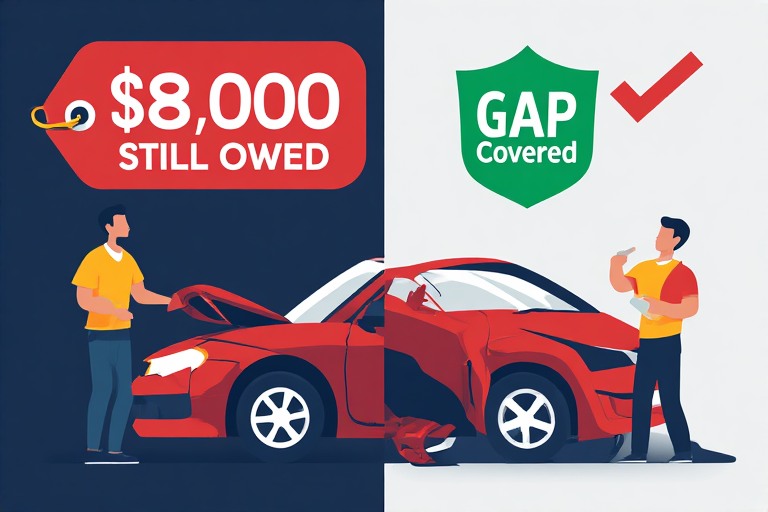
Car depreciation hits hard and fast. The moment you drive off the lot, your vehicle can lose 10% to 20% of its value. If your car is written off or stolen six months later, your standard auto insurance only pays the current market value, not what you paid, not what you owe. That gap can be $3,000, $8,000, or even $15,000 out of your pocket.
That is exactly what gap insurance is designed to fix. For a full picture of how auto coverage works together, check out our complete guide to auto insurance.
WARNING: The Dealership Gap Trap Many dealerships bundle gap insurance directly into your finance agreement without clearly explaining the cost. You may end up paying $400 to $900 for the same coverage your auto insurer offers for $20 to $40 per year. Always check your loan paperwork before signing.
Table of Contents
What Is Gap Insurance?
Gap insurance, short for Guaranteed Asset Protection insurance, is an optional add-on coverage that covers the shortfall between your car’s actual cash value (ACV) and the outstanding balance on your loan or lease at the time of a total loss.
Here is the core gap insurance scenario:
- You finance a $32,000 car.
- Two years later, it is totaled in an accident.
- Your insurer pays out the ACV: $22,000.
- You still owe $27,000 on your loan.
- Without gap insurance, you owe $5,000 out of pocket on a car you no longer have.
- With gap insurance, that $5,000 shortfall is covered (minus your deductible).
Gap insurance does not replace your full auto policy. It works on top of your comprehensive and collision coverage. According to the Insurance Information Institute (III), new cars depreciate by an average of 20% in the first year alone, making gap insurance particularly valuable for new car buyers.
How Does Gap Insurance Work? Step-by-Step
Step 1: Your Car Is Declared a Total Loss or Stolen
Gap insurance only kicks in when your vehicle is a total loss from an accident, fire, flood, or theft. It does not cover repairs, engine failure, or mechanical problems.
Step 2: Your Primary Insurer Pays Actual Cash Value
Your comprehensive or collision coverage pays out the current market value of your vehicle at the time of the incident. This is the ACV, which accounts for depreciation.
Step 3: Gap Insurance Covers the Shortfall
Your gap insurance policy then calculates the difference between your insurer’s ACV payout and your outstanding loan or lease balance. It pays that difference directly.
Step 4: Your Loan Is Cleared
The lender receives the full payoff. You walk away without carrying loan payments on a car you cannot drive.
Important: Gap insurance typically does not cover overdue payments, penalties, extended warranties rolled into the loan, or finance charges. Always read your policy wording carefully.
Real-World Case Study:
Marcus bought a 2023 Ford F-150 in January 2023 with a $2,000 down payment and financed $42,000 over 72 months. By November 2023, the truck was totaled in a highway accident. His insurer paid out $33,500 based on the current ACV. His loan balance was still $40,800.
Without gap insurance, Marcus would have owed $7,300 on a truck sitting in a salvage yard.
Because he added gap insurance through Progressive at $38 per year, his policy covered the $7,300 shortfall. He paid nothing out of pocket beyond his $500 deductible.
Total cost of his gap insurance over 11 months: about $35. Total money saved: $7,300.
Gap Insurance Cost in 2026
USA: Gap Insurance Cost
Gap insurance cost in the US depends on whether you buy through your auto insurer or through a dealership. The difference is substantial.
| Where You Buy | Average Gap Insurance Cost 2026 |
|---|---|
| Added to existing auto policy | $20 to $40 per year |
| Standalone gap insurance policy | $200 to $300 per year |
| Through a dealership | $400 to $900 (lump sum, often financed) |
| Through a lender | $150 to $300 per year |
Winner: Buy through your auto insurer. Adding gap insurance to an existing Progressive, State Farm, or Nationwide policy is by far the cheapest route in 2026. Dealership gap insurance is the most expensive and you may pay interest on it if it is rolled into your loan.
Key factors that affect gap insurance cost in the US:
- Your car’s actual cash value
- Your loan-to-value ratio
- Your state (some states regulate gap insurance pricing)
- Your age and driving history
According to Bankrate, drivers who purchase gap insurance through an independent insurer rather than a dealership save an average of $500 over the life of a loan.
UK: Gap Insurance Cost
UK gap insurance cost is structured differently. Policies are typically sold for a fixed multi-year term rather than as an annual add-on.
| Policy Type | Average UK Gap Insurance Cost 2026 |
|---|---|
| Return to Invoice (3 years) | £69 to £149 |
| Vehicle Replacement (3 years) | £89 to £199 |
| Contract Hire GAP (3 years) | £79 to £169 |
| Dealership-sold gap | £200 to £450 |
Winner: Independent broker over dealership. UK providers like ALA Insurance and Quotezone typically offer Return to Invoice gap insurance starting from around £69 for a 3-year policy, compared to £200 or more at a dealership.
Note: UK drivers have a 14-day cooling-off period after purchasing gap insurance from a dealership, meaning you can cancel and buy independently for less.
Gap Insurance Quote: Where to Get One
USA: Getting a Gap Insurance Quote
The easiest way to get a gap insurance quote in the US is to contact your existing auto insurer and ask to add loan/lease payoff coverage to your current policy. Major providers offering gap insurance or equivalent coverage in 2026:
- Progressive: Offers “Loan/Lease Payoff” coverage, capped at 25% of the car’s ACV
- State Farm: Offers payoff coverage as a policy add-on
- Nationwide: Full gap insurance add-on with no percentage cap in most states
- GEICO: Does not offer traditional gap insurance but partners with some lenders
- Allstate: Gap insurance available in select states
Always ask for a gap insurance quote before visiting a dealership. Knowing your insurer’s rate gives you a strong negotiating position.
🇬🇧 UK: Getting a Gap Insurance Quote
In the UK, you must be offered a 2-day deferral period before a dealership can sell you gap insurance under Financial Conduct Authority (FCA) rules. This gives you time to shop around.
UK providers to compare for a gap insurance quote:
- ALA Insurance: One of the largest dedicated UK gap insurance providers, offering Return to Invoice, Vehicle Replacement, and Contract Hire policies
- Quotezone: Comparison site for gap insurance quotes across multiple UK providers
- Direct Line: Offers return to invoice gap insurance as part of their auto add-ons
- GardX: Commonly sold through franchised dealerships
Types of Gap Insurance for Cars
Not all gap insurance for cars works the same way. Here is a quick breakdown of the main types.
Finance/Loan Gap Insurance (US Focus)
The most common form in the US. Covers the difference between your insurer’s ACV payout and your outstanding loan balance. Works for both new and used car purchases.
Lease Gap Insurance (US and UK)
If you lease, many lease agreements already include gap coverage. However, some do not, and the FCA in the UK and the NAIC in the US both recommend verifying your lease agreement before assuming you are covered.
Return to Invoice (RTI) Gap Insurance (UK Focus)
Pays the difference between your insurer’s settlement and the original purchase price (invoice price) you paid. Very popular in the UK. Offered by ALA, Quotezone, and Direct Line.
Vehicle Replacement Gap Insurance (UK Focus)
Pays the cost of replacing your vehicle with an equivalent model at current market prices, even if prices have risen since you bought your car. The most comprehensive UK option.
Contract Hire Gap Insurance (UK Focus)
Designed for leased vehicles with no purchase option. Covers remaining monthly rentals and any shortfall in the insurer’s market value payout versus what the leasing company expects.
How Does Gap Insurance Work Through a Dealership?
Buying gap insurance through a dealership is the most common route, but it is often the most expensive and the least transparent.
Here is exactly how the dealership gap insurance process works:
Step 1: The finance manager presents gap insurance as part of your loan package, usually framed as a small monthly addition to your payment.
Step 2: The premium is often rolled into your loan principal, meaning you pay interest on your gap insurance for the full loan term.
Step 3: Dealership gap coverage may have payout caps, exclusions, or terms that differ from insurer-issued policies.
Step 4: If you pay off your loan early, dealership gap insurance may not refund unused premium. Independent insurer policies usually do.
The bottom line on dealership gap insurance: It is convenient, but it costs significantly more and offers less flexibility. Always get a gap insurance quote from your auto insurer first, then compare.
If your dealership has already added gap insurance to your loan without your knowledge, read our guide on common driveaway insurance mistakes to understand your rights.
Do You Actually Need Gap Insurance for Your Car?
Gap insurance for cars makes sense in specific situations. Use this quick checklist:
You likely NEED gap insurance if:
- You put less than 20% down when buying your car
- Your loan term is 60 months or longer
- You are leasing a vehicle (check if your lease already includes it)
- You bought a car model known for fast depreciation (luxury vehicles, certain EVs, sports cars)
- You rolled negative equity from a previous loan into your new loan
You probably do NOT need gap insurance if:
- You paid cash for your car
- Your loan balance is already less than the car’s current ACV
- You put 30% or more as a down payment
- Your car is more than 5 years old and the loan balance is low
According to the National Association of Insurance Commissioners (NAIC), negative equity (owing more than a car is worth) affects approximately 33% of trade-in vehicles in the US, making gap insurance a practical safeguard for a large portion of car buyers.
Gap Insurance and Electric Vehicles
EV depreciation in 2025 to 2026 has been unusually aggressive. Some models lost 30% to 40% of their value within 12 months. This makes gap insurance especially important for EV buyers.
MBI Tip: If you are buying an EV or a specialist vehicle, also consider Mechanical Breakdown Insurance (MBI) to cover the gap in your manufacturer’s warranty, particularly for expensive battery replacements not covered by standard auto policies. Gap insurance covers the financial shortfall on a total loss; MBI covers costly repairs before a total loss happens. Using both together gives you comprehensive financial protection.
For more on EV-specific coverage considerations, check out our article on usage-based car insurance pros and cons.
Gap Insurance Calculator
Use the formula below to estimate your gap exposure before buying a policy.
Your Gap Exposure Formula:
Gap Exposure = Current Loan Balance - Current ACV of Your Car

If Gap Exposure > $0: You are "upside down" and gap insurance is worth considering.
If Gap Exposure = $0 or negative: You have positive equity and may not need gap insurance.
Example:
- Current loan balance: $26,500
- Current ACV (check Kelley Blue Book or Glass’s Guide): $21,000
- Gap Exposure: $26,500 – $21,000 = $5,500
A $5,500 exposure costs you $5,500 out of pocket if your car is totaled. Gap insurance costs $30 per year. The math is clear.
Gap Insurance Calculator Tool
Gap Insurance Calculator
Find out your gap exposure and estimated coverage cost instantly
Find this on your latest loan statement
Check Kelley Blue Book (US) or Glass’s Guide (UK)
Found on your auto insurance policy declarations page
Your Situation (select all that apply):
Gap Insurance vs. Standard Auto Insurance: What Is the Difference?
| Feature | Standard Auto Insurance | Gap Insurance |
|---|---|---|
| Pays ACV on total loss | Yes | No (works alongside it) |
| Covers loan/lease shortfall | No | Yes |
| Required by law | Yes (liability minimum) | No |
| Covers repairs | Yes | No |
| Covers theft | Yes (comprehensive) | Yes (shortfall only) |
| Average annual cost | $1,700+ (full coverage) | $20 to $40 add-on |
If you have had a claim denied by your standard insurer, read our guide on why insurance companies deny claims to understand your options.
Top 3 Cheapest Ways to Buy Gap Insurance in 2026
| Rank | Method | Estimated Cost | Best For |
|---|---|---|---|
| 1 | Add to existing auto policy | $20 to $40/year | Most US drivers |
| 2 | Independent UK broker (ALA, Quotezone) | £69 to £149 for 3 years | UK drivers |
| 3 | Standalone insurer policy | $200 to $300/year | Drivers without qualifying existing policies |
| Avoid | Dealership financing | $400 to $900 lump sum | No one |
Gap Insurance and Young Drivers
Young drivers are statistically more likely to total a vehicle within the first few years of purchase, and they often take on longer loan terms with smaller down payments, making the gap exposure larger. If you are under 25 and financing a car, gap insurance is one of the smartest add-ons available.
Read our in-depth guide on cheap car insurance for young drivers under 25 for more money-saving strategies.
Can You Commit Fraud with Gap Insurance?
Attempting to fake a total loss or staging an accident to claim gap insurance is a serious crime. In the US, insurance fraud is prosecuted at both state and federal levels, with penalties including heavy fines and prison time. In the UK, the Insurance Fraud Enforcement Department (IFED) actively investigates fraudulent gap insurance claims. Read our article on car insurance fraud punishment to understand the full legal consequences.
Verification Table
| Claim | Source | Date |
|---|---|---|
| New cars depreciate ~20% in year one | Insurance Information Institute (III) | 2025 |
| US gap insurance add-on: $20 to $40/year | Nationwide, Bankrate | 2026 |
| Dealership gap insurance: $400 to $900 lump sum | Bankrate, Consumer Reports | 2026 |
| 33% of US trade-ins carry negative equity | NAIC | 2025 |
| UK RTI gap insurance from £69 (3 years) | ALA Insurance | 2026 |
| UK FCA mandates 2-day deferral period for dealer gap sales | Financial Conduct Authority | 2024 |
| Progressive Loan/Lease Payoff capped at 25% ACV | Progressive.com | 2026 |
This article is for informational purposes only and does not constitute financial or insurance advice. Always compare gap insurance quotes from multiple providers before purchasing. Policy terms vary by state, country, and insurer.
Frequently Asked Questions About Gap Insurance
Q1: What is gap insurance in simple terms?
Gap insurance covers the money you still owe on your car loan after your standard insurer pays out the car’s current market value following a total loss or theft. It bridges the financial gap between what insurance pays and what you owe.
Q2: How much does gap insurance cost per month?
In the US, when added to an existing auto policy, gap insurance costs roughly $1.67 to $3.33 per month. Bought through a dealership, the cost rises to $30 to $75 per month when financed into your loan.
Q3: Can I buy gap insurance at any time?
Most insurers require you to purchase gap insurance within a certain window of buying the car, often within 30 to 180 days of purchase. After that, your options narrow. Some providers offer agreed value policies for older vehicles.
Q4: Does gap insurance cover a stolen car?
Yes. If your car is stolen and not recovered, and the ACV payout from your comprehensive cover is less than your outstanding loan balance, gap insurance covers the shortfall.
Q5: Is gap insurance worth it on a used car?
It can be. If you financed a used car with a small down payment and the car depreciates faster than you pay down the loan, gap insurance protects you. The key question: does your loan balance exceed the car’s ACV? If yes, gap insurance is worth it.
Q6: How long do I keep gap insurance?
Keep gap insurance until your outstanding loan balance falls below your car’s current market value. At that point, you have positive equity and no longer need it. Most drivers can drop gap insurance 2 to 3 years into a standard loan term.
Q7: Does gap insurance cover my deductible?
Standard gap insurance does not cover your collision or comprehensive deductible. Some policies offer a deductible waiver as an add‑on – worth checking when getting a gap insurance quote.
Q8: Can I cancel gap insurance from a dealership?
Yes. In the US, dealership gap policies are cancellable, and you should receive a prorated refund on unused premium. In the UK, you have a 14‑day cooling‑off period under FCA rules. Contact your lender or dealer directly to start the cancellation process.
Q9: What is the difference between gap insurance and return to invoice?
Standard gap insurance (US‑style) pays the outstanding loan balance. Return to Invoice (RTI, mainly UK) pays the difference between the insurer’s payout and the original purchase invoice price – which may be more or less than the loan balance depending on your situation.
Q10: Does gap insurance pay out if I am at fault in an accident?
Yes. Fault determination affects your liability and collision coverage, but gap insurance pays out regardless of fault as long as your vehicle is declared a total loss and you have the required comprehensive and collision coverage in place.