
Maybe you’ve heard someone brag about “beating the system.” Maybe you’ve wondered if fudging your mileage or “forgetting” that fender bender really matters. Here’s the reality: car insurance fraud punishment is no slap on the wrist. It’s life-altering. And it’s more common than you think.
Table of Contents
Car Insurance Fraud Punishment
Most people picture staged accidents and fake injuries when they hear “fraud.” But car insurance fraud punishment covers a spectrum—from “soft” lies to organized crime.
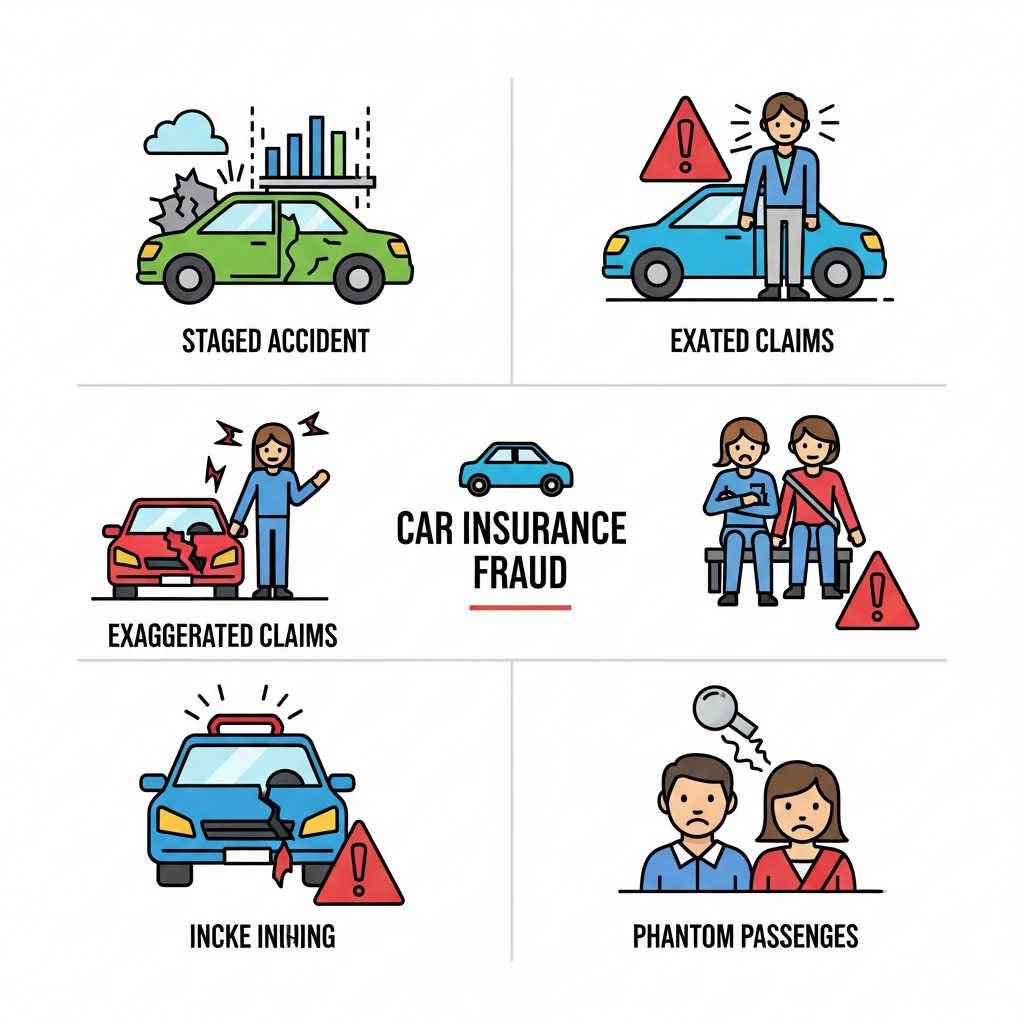
As explained by the III [https://www.iii.org/article/insurance-fraud], fraud falls into two buckets:
Soft Fraud (Opportunistic)
- Underreporting annual mileage
- “Garaging” your car at a parent’s address while living in a high-premium city
- Omitting past accidents or tickets
- Exaggerating damages after a legitimate accident
Hard Fraud (Premeditated)
- Staging collisions
- Faking injuries with medical provider collusion
- Reporting stolen vehicles that were sold or abandoned
- Intentionally causing damage for payouts
NerdWallet notes [https://www.nerdwallet.com/article/insurance/car-insurance-fraud] that soft fraud feels harmless to perpetrators—everyone does it, right?—but insurers paid over $30 billion in fraudulent claims annually in recent years. That cost flows directly to honest drivers through higher factors affecting car insurance premiums.
What Count as fraud?
Criminal Penalties
| Offense Level | Typical Punishment | Real-World Example |
|---|---|---|
| Misdemeanor fraud (<$950-$2,500) | Up to 1 year jail, fines, restitution | California man inflated repair quote by $800; 6 months probation, $3,200 restitution |
| Felony fraud ($2,500-$50,000) | 1-5 years prison, $10,000+ fines | Florida ring staged 50 accidents; 3 years prison, $127,000 restitution |
| Aggravated/organized fraud (>$50,000 or injury) | 5-15+ years, massive fines, RICO charges | New York no-fault scheme with fake clinics; 10 years federal prison, $2.1 million forfeiture |
The NAIC warns [https://content.naic.org/article/consumer-alert-insurance-fraud] that car insurance fraud punishment varies by state, but prosecutors increasingly pursue felony charges for amounts that once triggered misdemeanors. Why? Fraud databases now track patterns across insurers, making “first-time” offenders look like serial perpetrators.
Real Cases That Made Headlines
The “Swoop and Squat” Ring (2023)
A Los Angeles group used three vehicles to force rear-end collisions, then filed injury claims with complicit medical clinics. Result: 12 convictions, sentences ranging 18 months to 7 years, $4.3 million in ordered restitution. The ringleader faced car insurance fraud punishment including federal mail fraud charges.
The Phantom Passenger (2022)
A Ohio woman claimed whiplash from a minor fender bender—then investigators found social media posts of her running a 5K that same weekend. She faced felony charges, 90 days jail, and a $15,000 civil judgment from the insurer.
The Address Shuffle (2024)
A Michigan man saved $800 annually by registering his car at his parents’ rural address while living in Detroit. When his car was stolen from his actual apartment, the claim denial triggered fraud investigation. Result: Policy rescission, denied theft claim, and criminal charges for rate evasion.
The Hidden Punishments
Car insurance fraud punishment extends far beyond courtrooms.
Financial Ruin
- Restitution orders: You repay every fraudulent dollar, often with interest
- Civil judgments: Insurers sue for investigation costs, legal fees, punitive damages
- Tax consequences: Settled claims may generate 1099 income; restitution rarely deducts
Insurance Blacklisting
Bankrate explains [https://www.bankrate.com/insurance/car/car-insurance-cancellation/] that fraud findings enter national databases (CLUE, A-PLUS) for 5-7 years. During this period:
- Standard insurers refuse coverage
- “High-risk” policies cost 3-5x normal rates
- Some states require SR-22 filings, publicly flagging your record
Collateral Damage
- Employment: Fraud convictions bar many professional licenses
- Housing: Background checks reveal criminal records
- Future claims: Even honest accidents get scrutinized heavily
Consumer Reports notes [https://www.consumerreports.org/cro/car-insurance/car-insurance-complaints] that fighting a denied claim after fraud allegations costs thousands in legal fees—often exceeding the original disputed amount.
How Insurers Catch You
The car insurance fraud punishment risk has grown because detection got smarter.
Telematics and Data
Usage-based insurance programs (Snapshot, Drivewise, etc.) record actual mileage, location, and driving patterns. Claim you drive 5,000 miles annually? Your app shows 12,000. Red flag.
Social Media Mining
That ski trip photo timestamped during your “disabling back injury”? Public posts are legally admissible. Investigators routinely monitor claimants’ social accounts.
Cross-Referencing Databases
Forbes details [https://www.forbes.com/advisor/car-insurance/insurance-fraud/] how insurers share data through:
- ISO ClaimSearch: 1 billion+ claims records
- NICB (National Insurance Crime Bureau): Vehicle theft and fraud patterns
- State fraud bureaus: Mandatory reporting in most jurisdictions
AI Pattern Recognition
Modern algorithms flag suspicious combinations: specific repair shops, certain medical providers, identical damage descriptions. What looked random to human adjustors reveals organized schemes to machine learning.
The Claims Process
Understanding claims process in auto insurance helps explain why fraud often fails.
When you file a claim, specialized adjustors evaluate:
- Coverage verification: Was the policy obtained through misrepresentation?
- Loss circumstances: Does the damage match the reported cause?
- Injury documentation: Are treatments reasonable for the mechanism?
- Third-party reports: Police, witnesses, surveillance footage
The Zebra emphasizes [https://www.thezebra.com/auto-insurance/claims/] that even legitimate claims face scrutiny when factors affecting car insurance premiums suggest higher risk profiles. Fraudulent claims? They unravel quickly under investigation.
Protecting Yourself (From Others and Yourself)
If You’re a Victim
- Document everything at accident scenes
- Photograph all vehicles, damage, license plates
- File police reports for any collision
- Notify your insurer immediately if you suspect staged accidents
If You’re Tempted
Remember: Car insurance fraud punishment rarely fits the “savings” you imagined. That $500 rate reduction costs years of freedom, tens of thousands in restitution, and permanent reputational damage.
Investopedia advises [https://www.investopedia.com/terms/i/insurance-fraud.asp] that policy rescission—retroactive cancellation—means insurers treat your policy as never existing. You repay all claims, lose all “coverage” you thought you had, and still face criminal charges.
Frequently Asked Questions
What’s the most common type of car insurance fraud?
Rate evasion—misrepresenting where you garage your vehicle or who primarily drives it. It feels victimless but costs insurers billions and drives up everyone’s auto insurance coverage types costs.
Can I go to jail for lying about my address on an insurance application?
Yes. While small discrepancies might trigger policy cancellation and back-premium charges, systematic misrepresentation to obtain lower rates constitutes fraud. Multiple states now prosecute address fraud as misdemeanors or felonies depending on amounts involved.
How long does insurance fraud stay on my record?
Criminal convictions remain permanently. Insurance database entries (CLUE, A-PLUS) typically last 5-7 years. Some states allow expungement for first-time offenders after sentence completion, but insurance industry databases may retain information longer.
What if I didn’t mean to commit fraud?
Intent matters legally. Accidental errors—transposing digits in mileage, forgetting an old claim—usually result in policy corrections, not prosecution. However, pattern evidence (multiple “errors” all benefiting you) suggests intent to investigators.
Can insurers deny my claim without proving fraud?
Yes. Insurers need only show policy violations or coverage exclusions. Fraud allegations trigger deeper investigation, but denials can occur for simpler reasons: lapsed payments, excluded drivers, or uncovered perils.
What should I do if accused of fraud?
Stop communicating with insurers immediately and consult an attorney specializing in insurance law. Signed statements given during investigations can be used criminally. The car insurance fraud punishment process allows defense, but early missteps complicate it.
Do insurers reward people who report fraud?
Some states and insurers offer whistleblower rewards, typically 10% of recovered funds. The NICB operates anonymous tip lines. However, most fraud detection comes from data analysis, not citizen reporting.
Can fraud affect my family members’ insurance?
Indirectly, yes. If you’re convicted of fraud involving a shared policy or vehicle, family members may face coverage difficulties, premium increases, or exclusion from certain auto insurance coverage types until the database entry expires.
The Bottom Line
Car insurance fraud punishment is severe, certain, and increasingly automated. The short-term “wins” of misrepresentation evaporate the moment an investigator opens your file. And they will—insurers spend billions annually on fraud detection because it saves billions more in prevented payouts.
Honesty isn’t just ethical; it’s practical. Accurate disclosures ensure your claims process in auto insurance proceeds smoothly when you actually need help. The alternative? Financial devastation, criminal records, and the enduring regret of trading integrity for a few hundred dollars in premium savings.
Drive safely. Report accurately. Sleep soundly.
Educational only; consult advisor. Data as of February 2026.