
- Yes — but only for guests and visitors, never for you or your household
- Liability pays medical bills, lost wages, and your legal defense up to your limit
- Medical payments covers minor guest injuries regardless of fault ($1K–$5K)
- Does NOT cover intentional acts, business visitors, roommates, or your own injuries
- $100K liability costs just $23/month — upgrading to $300K adds only $1.50/month more
- Cheapest option: State Farm at $15/month for $100K liability + $40K property
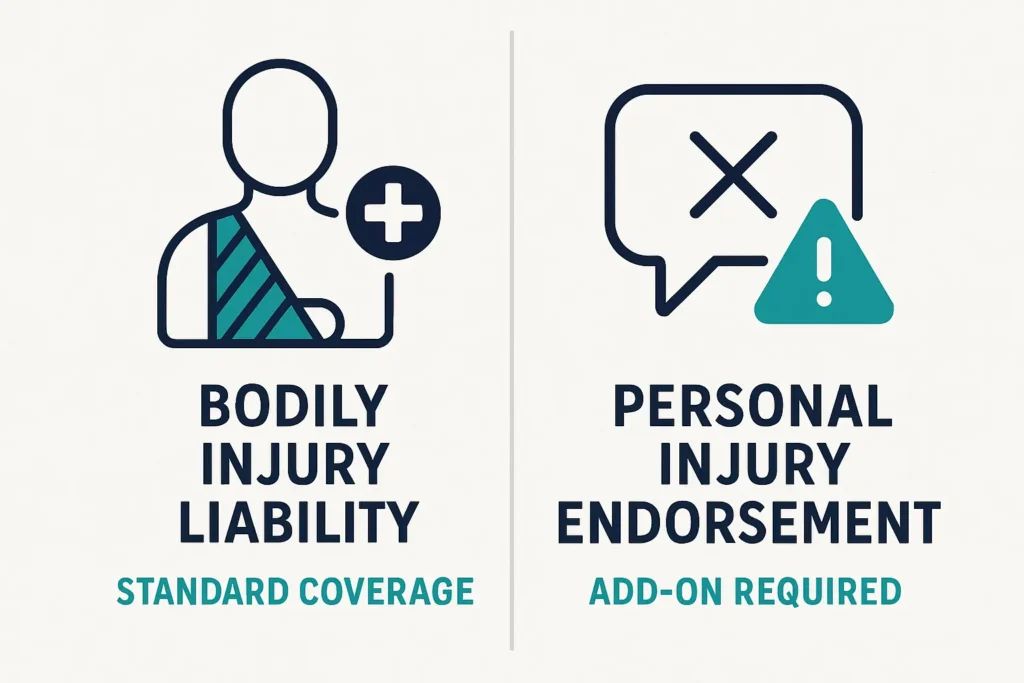
In insurance language, “personal injury” means defamation, slander, or invasion of privacy — not physical injury. Guest slip-and-falls are covered under bodily injury liability, which is standard. The personal injury endorsement (for lawsuits over what you post online) is a separate, optional add-on most policies exclude by default.
| Provider | $100K Liability/mo | $300K Liability/mo | Dog Breeds | Personal Injury Add-on? |
|---|---|---|---|---|
| State Farm | $15/mo | ~$16.50/mo | Some excluded | Check locally |
| Lemonade | ~$16/mo | ~$17.50/mo | Varies by state | Yes (4 states) |
| GEICO | ~$18/mo | ~$19.50/mo | No restriction | Varies |
| Allstate | ~$21/mo | ~$22.50/mo | Some excluded | Varies |
| Travelers | ~$22/mo | ~$24/mo | Some excluded | Higher limits avail. |
| National Average | $23/mo | $24.50/mo | $300K costs just $1.50/month more — almost always worth it | |
Sources: Insurance.com (Jan 2026), Insurify (2026), Lemonade (Jan 2026), MoneyGeek (Dec 2025).
Someone gets hurt at your apartment. A guest trips over your coffee table, your dog bites a delivery driver, or a friend slips on your bathroom floor and breaks their wrist. The first question that runs through your head: does renters insurance cover personal injury?
The answer is yes — but with important limits, a terminology trap that confuses thousands of renters, and several scenarios where your policy will absolutely not help you. This guide untangles all of it: what renters insurance personal injury coverage actually pays for, what it excludes, how much liability protection you actually need, which providers handle it best, and what a real claim looks like from first incident to payout.
Table of Contents
The Terminology Problem: “Personal Injury” Means Two Different Things
Before answering whether renters insurance covers personal injury, you need to know that this phrase means something completely different to a renter versus an insurance underwriter.
What most renters mean: A guest physically gets hurt at my apartment. Slip-and-fall, dog bite, object falling from a shelf, injury from my pet. This is bodily injury liability — and standard renters insurance covers it.
What insurance policies mean by “personal injury”: Non-physical harm to someone’s reputation, privacy, or emotional well-being. Libel (written false statements), slander (spoken false statements), defamation, invasion of privacy, wrongful eviction. This is a personal injury endorsement — a separate, optional add-on that most standard policies do not include by default.
This distinction matters because if you search “does renters insurance cover personal injury” and find the answer “yes,” you may be reading about the endorsement — and assume your bodily injury claims are also covered by that. Or vice versa: you read “yes, bodily injury is covered” and assume you’re also protected if someone sues you for something you posted about them online.
Throughout this guide: when we say personal injury, we mean physical injury to a guest. When we mean the insurance endorsement for non-physical harm, we say personal injury endorsement. Most renters need to understand the first category; the second is addressed later in its own section.
Does Renters Insurance Cover Personal Injury to Guests? Yes, Here Is How
Standard renters insurance covers physical injury to guests and visitors through two coverage components that work together:
Personal Liability Coverage The Foundation
Personal liability coverage is the component of your renters insurance that pays when you are legally responsible for someone else’s injury or property damage. It activates when:
- A guest is injured in your rental unit due to your negligence
- Someone is injured off-premises due to your negligence (example: your dog bites someone at a park)
- You or a household member accidentally damages someone else’s property
“Legally responsible” is the operative phrase. If a guest slips on a spill you left on the kitchen floor for hours, you are likely negligent — and your liability coverage responds. If a guest trips over their own feet on a perfectly maintained floor, you are less likely to be found negligent, though your medical payments coverage (see below) may still help.
Personal liability pays for: the injured person’s medical bills, their lost wages if they claim income was affected by the injury, pain and suffering damages awarded by a court, and your legal defense fees — attorney costs, court filing fees, and settlement negotiations. All of this comes out of your single policy limit.
Standard liability limits in renters insurance start at $100,000 and go up to $500,000. The Insurance Information Institute confirms that the typical renter’s policy offers $100,000 minimum in liability coverage. MoneyGeek recommends carrying at least $300,000.
What personal liability does NOT cover:
- Your own injuries (you are not a third party to your own policy)
- Injuries to household members — spouses, roommates, children, others who live with you
- Injuries caused intentionally
- Injuries connected to business activities conducted in your rental
- Motor vehicle accidents (auto insurance handles these)
- Injuries in common areas of your building (hallways, lobby, parking lot) unless you directly caused them through negligence

Medical Payments to Others Coverage
Medical payments coverage (MedPay) is a smaller, supplementary coverage that pays for a guest’s immediate medical expenses regardless of who was at fault. You do not have to be legally responsible for it to activate — it pays automatically when a guest is injured on your premises.
Standard MedPay limits in renters insurance run $1,000 to $5,000. Lemonade’s default is $1,000 with optional increase to $5,000. Most major carriers offer up to $5,000 per incident.
The practical value of MedPay: it prevents small injury incidents from escalating into formal liability claims. If a guest cuts their hand and needs urgent care stitches — a $400–$800 visit — your $1,000 MedPay coverage handles it quietly, before lawyers become involved and before the injury is formally attributed to your negligence.
MedPay does not require a lawsuit, does not require establishing fault, and does not affect your liability limit. It is a separate, immediate-response fund for minor injuries.
Example: A friend trips over your video game controller and fractures their wrist. Emergency care and casting costs $25,000. Your MedPay covers the first $5,000 immediately and without fault determination. Your personal liability then pays the remaining $20,000 if your friend files a claim against you.
What Does Renters Insurance Liability Coverage Actually Pay For?
When a covered personal injury claim moves into liability territory, here is what your renters insurance covers in practical terms:
Medical expenses: ER visits, hospitalization, surgery, physical therapy, follow-up specialist appointments, prescription medications. All covered up to your policy limit.
Lost wages: If the injured guest can demonstrate they missed work due to the injury, your liability coverage pays their documented lost income as part of the claim settlement.
Pain and suffering: A court may award damages beyond medical bills and lost wages to compensate for the physical and emotional suffering caused by the injury. Renters liability covers these court-ordered awards up to your limit.
Legal defense fees: Attorney’s fees, court filing costs, expert witness fees, and deposition costs can exceed $50,000 in a contested personal injury case even if you ultimately win. Renters insurance covers your defense whether you are found liable or not. The coverage does not require a judgment against you to activate the legal defense component.
Property damage: If your negligence also damages the guest’s property — their laptop was broken in the same fall, for instance — liability coverage pays for that too.
Real claim scenario: A guest trips over your dog’s toy and fractures a wrist. Their medical costs reach $25,000. They sue for $40,000 total, claiming pain and suffering and three weeks of missed work. Your $100,000 policy covers the full settlement plus your attorney’s fees ($12,000 in legal costs). Total payout from your policy: $52,000. Your out-of-pocket: your deductible if applicable (most renters liability claims have no deductible). (Source: Mattiacci Law, April 2025.)
What Renters Insurance Personal Injury Coverage Does NOT Cover
Understanding exclusions is as important as understanding what is covered. These are the scenarios where renters liability will not respond, regardless of your policy limit:
Your own injuries. If you fall down your own stairs, slip on your own bathroom floor, or are injured by your own furniture, renters insurance does not cover your medical bills. Your personal health insurance is the appropriate coverage for your own injuries. Renters insurance only responds to claims made by third parties.
Household members and roommates. Everyone named on the policy — and everyone living in the household — is excluded from liability claims. Your spouse, children, roommates, and domestic partners cannot be “guests” under your own renters policy. If your spouse is injured in your apartment, this is not a third-party claim. Their health insurance or your disability coverage is the relevant policy.
Intentional acts. Any injury you cause on purpose — a fight you start, deliberate property damage, any act of violence — is excluded from liability coverage. Intentional harm is excluded in every standard renters insurance policy without exception. This exclusion applies even if you are ultimately found legally liable in civil court.
Business activity exclusions. If you operate any business from your rental — freelance clients visiting, childcare services, personal training clients, tutoring sessions, e-commerce inventory storage — and a person connected to that business activity is injured, your renters policy typically excludes the claim. Business liability falls under commercial general liability insurance, not personal renters coverage. This exclusion is strict: even a single home-office client visit that results in an injury may be excluded.
Motor vehicle accidents. If a guest is injured in or by your car — even in your driveway or parking lot — auto insurance is the appropriate policy. Renters insurance explicitly excludes motorized vehicle liability. Your auto policy’s liability coverage responds to these claims.
Dog bite breed exclusions. Most major carriers restrict or exclude liability coverage for specific dog breeds. Common exclusions: pit bulls, Rottweilers, German shepherds, Akitas, Dobermans, Siberian huskies, chows, and wolf hybrids. Lemonade restricts coverage for these breeds in certain states per their 2026 policy documentation. GEICO is notable for offering liability coverage for most breeds without standard restrictions. Always verify your specific breed is covered before relying on renters liability for dog bite claims.
Common area injuries. Your liability coverage extends to your rental unit and areas within your reasonable control. Injuries in shared building hallways, lobby areas, stairwells, parking lots, or the building exterior are typically the landlord’s responsibility — not yours — unless you directly caused the hazard.
Injuries above your coverage limit. If a serious injury results in a judgment that exceeds your liability limit — a permanent disability claim, for example — you are personally responsible for the amount above your policy limit. This is the scenario that justifies carrying $300,000 or more in coverage and considering a personal umbrella policy.
Personal Injury Endorsement The Non-Physical Harm Coverage
Now for the other definition of personal injury in insurance: harm that does not involve physical injury but causes legal and financial damage nonetheless.
A personal injury endorsement on a renters insurance policy covers:
- Defamation — false statements you make, written or spoken, that damage someone’s reputation
- Libel — written defamatory content, including social media posts, emails, and reviews
- Slander — spoken defamatory statements
- Invasion of privacy — sharing or publishing private information about someone without consent
- False arrest/wrongful detention — accusations that cause someone to be wrongfully detained
- Malicious prosecution — filing false legal claims against someone
This endorsement is not automatically included in most standard renters policies. Lemonade offers it in Utah, Georgia, Ohio, and South Carolina as of 2026, with additional states coming. Progressive offers enhanced packages that include personal injury protection for renters in some states.
The real-world relevance is growing. In 2026, a renter who posts a damaging review of a roommate, shares compromising photos without consent, or makes false public accusations on social media faces genuine legal exposure that standard bodily injury liability does not cover. If you are active on social media and interact publicly with neighbors, former partners, or landlords, a personal injury endorsement deserves serious consideration.
If your state and carrier do not offer this endorsement for renters insurance, some personal umbrella policies include personal injury protection as part of their coverage package.
Does Renters Insurance Cover Personal Injury on Their Property?
One of the most searched variations of this question: does renters insurance cover personal injury that happens outside the rental unit?
The answer depends on the type of incident.
Personal liability generally extends off-premises for incidents you are personally responsible for. Classic example: your dog bites someone at the dog park. You are at the dog park, not your apartment — but the liability follows you as the policyholder. State Farm explicitly states that liability coverage applies whether the incident occurred within your residence or elsewhere.
Medical payments coverage is typically limited to your premises. MedPay activates when someone is injured on your rental property. It does not typically follow you off-premises.
What this means practically:
- Guest injured in your apartment: liability + MedPay apply
- You injure someone at a park through your negligence: liability applies (no MedPay)
- Guest injured in your car: auto insurance, not renters
- Guest injured in a shared building hallway: landlord’s liability, not yours (unless you created the hazard)
- Guest injured at a rented Airbnb vacation you are hosting: likely not covered renters insurance covers your primary residence, not temporary hosted locations
Always check your specific policy declarations page. Some carriers explicitly describe the geographic scope of liability coverage in Section II of the policy.
How Much Renters Liability Coverage Do You Actually Need?
The standard answer $100,000 is the minimum, not the recommendation.
The average renters insurance policy with $100,000 liability and $40,000 property coverage costs $23 per month, or $270 per year (Insurance.com, January 2026). Increasing that liability limit to $300,000 adds approximately $18 per year or $1.50 per month to the same policy. For three times the legal protection at essentially the same cost, $300,000 should be the starting point for most renters, not the maximum.
Here is a framework for choosing the right amount:
$100,000 is sufficient if:
- You rarely have guests at your rental
- You have no pets
- You have no minors living with you
- Your total net assets (savings, investments, property) are under $100,000
- Your lease requires $100,000 minimum and you meet no elevated risk factors
$300,000 is the right floor if:
- You host guests frequently — parties, regular visitors, overnight guests
- You own a dog — even a well-behaved one. A single dog bite resulting in permanent scarring or nerve damage can exceed $100,000 in medical and legal costs
- You have minor children who could injure others
- Your personal assets exceed $100,000
$500,000 is appropriate if:
- You own multiple pets or a breed with a history of liability claims
- You have a trampoline, hot tub, or pool in or around your rental
- Your net worth significantly exceeds $300,000 and you would face meaningful personal financial loss from a judgment above your limit
- You host business-related events at your home (though verify this is not excluded as a business activity)
Umbrella policy: If your risk profile justifies more than $500,000 in liability protection — you have significant assets, you are a landlord in addition to a renter, or you run a business — a personal umbrella policy provides $1 million to $5 million in additional liability above your renters and auto policy limits. Umbrella policies typically cost $150 to $300 per year for $1 million in additional coverage.
Does State Farm Renters Insurance Cover Personal Injury?
State Farm is the most searched individual carrier for this question, and the answer is yes — with the same coverage structure as the industry standard.
State Farm renters insurance covers bodily injury liability at its default $100,000 minimum, with options to increase. It costs an average of $15 per month for $100,000 in liability paired with $40,000 in personal property coverage (Insurify, 2026). That is the cheapest average among major carriers.
State Farm’s renters liability is explicit: the policy covers costs if you are held responsible for another person’s injury or damage to their property. The coverage applies whether the incident occurred within your residence or elsewhere.
State Farm does not offer a personal injury endorsement (non-physical harm/defamation) as part of its standard renters insurance platform. It does, however, offer a personal liability umbrella policy that provides broader liability coverage above your renters and auto limits.
State Farm is not available for renters insurance in California, Massachusetts, or Rhode Island as of 2026.
Real Case Studies: When Renters Liability Coverage Paid and When It Didn’t
Case 1 Covered: Slip and Fall, $52,000 Claim
A renter in Dallas, Texas hosted a birthday party. A guest slipped on a spilled drink that had been on the kitchen floor for over an hour, fell, and fractured her wrist. The guest’s emergency care and orthopedic treatment cost $22,000. She subsequently sued for an additional $30,000 in lost wages and pain and suffering. The renter’s $100,000 personal liability coverage paid the full $52,000 settlement plus $11,000 in legal defense costs — all within the policy limit. The renter paid $0 out of pocket beyond their policy deductible. (Source: Mattiacci Law case study framework, April 2025.)
Case 2 Covered: Dog Bite Off-Premises
A renter in Atlanta, Georgia was at a public dog park with her lab mix when the dog bit another dog owner’s hand, causing lacerations requiring seven stitches and a hand specialist visit totaling $3,800. Because the liability followed her off-premises and the breed was not excluded under her GEICO renters policy, the claim was paid under her personal liability coverage. MedPay ($1,000) activated immediately; the remaining $2,800 was paid from liability.
Case 3 NOT Covered: Intentional Act
A renter in Chicago, Illinois got into a dispute with a neighbor and pushed them — the neighbor fell and fractured their elbow. Total medical and legal exposure: $67,000. The renter’s Allstate policy denied the claim entirely under the intentional acts exclusion. The renter faced the full judgment personally.
Case 4 NOT Covered: Home Business Client
A freelance photographer in Denver, Colorado used their apartment as a studio and was hosting a client shoot when the client tripped over a lighting cable and broke her ankle. The renter’s renters insurance denied the claim under the business activity exclusion. The photographer faced the claim without coverage and ultimately settled for $31,000 out of pocket. A home business liability endorsement or commercial general liability policy would have covered this.
Case 5 Partially Covered: Claim Exceeded Policy Limit
A renter in New York City carried $100,000 in personal liability. A guest suffered a serious fall that resulted in a traumatic brain injury requiring extended hospitalization and long-term care. The total judgment: $340,000. The renters policy paid $100,000 — the full limit. The renter was personally responsible for the remaining $240,000, which required liquidating savings and entering a payment plan. A $300,000 or $500,000 policy — or a personal umbrella policy — would have covered the full judgment.
HowTo: File a Personal Injury Liability Claim on Renters Insurance in 5 Steps
Step 1 Respond to the Incident First
Before thinking about insurance, ensure the injured person receives appropriate medical care. Call 911 if the injury is serious. Offer to call an ambulance. Document what happened immediately: take photos of the hazard, the scene, and the injury if possible and appropriate. Do not make any statements about fault, liability, or insurance coverage to the injured party in the immediate aftermath.
Step 2 Notify Your Insurer Promptly
Contact your renters insurance carrier as soon as possible after any incident that might result in a liability claim. Most carriers require prompt notification — delays can complicate your claim or give the insurer grounds to dispute coverage. You do not need to wait for a formal lawsuit to notify your insurer. Reporting the incident early opens a claim file and triggers your legal defense protection before a lawsuit is filed.
Step 3 Cooperate Fully with Your Insurer’s Investigation
Your insurer will assign a claims adjuster to investigate the incident. This includes gathering statements from you, the injured party, and any witnesses. Provide complete, accurate information. Do not exaggerate or downplay what happened. The adjuster is working to determine whether your liability coverage applies — your cooperation directly affects the speed and outcome of the process.
Step 4 Do Not Settle or Apologize Independently
Once you have notified your insurer, do not negotiate any settlement or make any financial payments to the injured party without your insurer’s knowledge and approval. Unauthorized settlements can void your coverage. Similarly, do not formally admit fault in writing — this can affect the legal determination of negligence and your insurer’s ability to defend the claim.
Step 5 Let Your Legal Defense Work
Your renters insurance covers your attorney’s fees from the moment a lawsuit is filed or threatened. Your insurer will assign or approve an attorney. Follow their guidance. Understand your policy limit and know whether the claim amount could approach or exceed it if so, discuss umbrella coverage options with your agent before a judgment is entered.
Frequently Asked Questions Renters Insurance and Personal Injury
Does renters insurance cover personal injury to visitors on their property? Yes. If a visitor or guest is physically injured in your rental and you are found legally negligent, renters insurance personal liability pays their medical bills, lost wages, pain and suffering damages, and your legal defense costs up to your policy limit ($100,000 to $500,000 depending on your coverage selection).
What does renters liability insurance cover beyond medical bills? Renters liability insurance covers the full scope of a third-party bodily injury claim: emergency medical care, hospitalization, specialist treatment and physical therapy, documented lost wages, court-awarded pain and suffering damages, and all legal defense costs — attorney fees, court filing fees, expert witnesses, and settlement negotiation costs.
Does renters insurance cover my own injury in my apartment? No. Renters insurance personal liability only covers third-party claims — injuries to people who do not live in your household. If you injure yourself in your own rental, your personal health insurance covers your medical bills.
What is $100,000 renters insurance liability coverage and what does it cost? $100,000 renters insurance means your policy will pay up to $100,000 toward a single covered liability claim, including medical bills, legal fees, and awarded damages. It costs $23 per month on average nationally for a policy with $100,000 liability and $40,000 personal property (Insurance.com, January 2026). State Farm offers it at $15 per month — the cheapest among major carriers.
Is $100,000 in renters liability enough? For renters with few guests, no pets, and modest personal assets, $100,000 provides a reasonable baseline. However, MoneyGeek and most financial advisors recommend at least $300,000 because serious injuries — those involving permanent disability, long-term care, or lost career earnings — routinely result in judgments exceeding $100,000. The cost difference between $100K and $300K is approximately $1.50 per month. The $300,000 limit is almost always worth it.
Does renters insurance cover dog bites? Yes — with breed exclusions that vary by carrier. Most policies cover dog bite liability, but pit bulls, Rottweilers, German shepherds, Dobermans, and several other breeds are excluded by many carriers. GEICO is the most permissive major carrier, covering most breeds without restriction. Lemonade restricts several breeds in certain states. Check your specific carrier’s breed exclusion list before assuming dog bite coverage.
Does renters insurance cover personal injury for defamation or slander? Not by default. This requires a personal injury endorsement — a separate add-on that most standard policies do not include. Lemonade offers it in Utah, Georgia, Ohio, and South Carolina. Progressive includes it in some enhanced renters packages. If your standard policy does not include this endorsement, a personal umbrella policy may provide defamation and privacy claim coverage.
What happens if a personal injury claim exceeds my renters insurance limit? You are personally responsible for the amount above your policy limit. This is the most important reason to carry adequate liability coverage and consider a personal umbrella policy. A judgment of $250,000 against a renter with a $100,000 limit means the renter owes $150,000 personally.
Source Verification Table
| Claim | Source | Published |
|---|---|---|
| Standard policies offer $100,000 or more in liability | Insurance Information Institute via Skaja Daniels Law | Oct 2025 |
| Personal liability covers $100,000–$500,000 per incident | MoneyGeek renters insurance injury coverage | Dec 2025 |
| MedPay covers $1,000–$5,000 regardless of fault | MoneyGeek renters insurance injury coverage | Dec 2025 |
| Lemonade personal injury endorsement: UT, GA, OH, SC | Lemonade renters insurance personal injury | Feb 2026 |
| $100K liability avg $23/mo, State Farm cheapest at $15/mo | Insurance.com $100K renters insurance | Oct 2025 / Jan 2026 |
| $300K liability adds only $18/year (~$1.50/mo) | Insurance.com average renters insurance rates | Jan 2026 |
| Average renters insurance: $24/mo, $288/year | Insurance.com average renters insurance | Jan 2026 |
| State Farm avg: $15/mo, $180/year | Insurify State Farm renters insurance review | 2026 |
| Lemonade avg: $16/mo | Lemonade renters insurance cost article | Jan 2026 |
| State Farm covers liability on and off premises | State Farm renters insurance how much do I need | Dec 2025 |
| Business activity exclusion standard across policies | Mattiacci Law, Lemonade policy docs | Apr 2025 / 2026 |
| GEICO covers most dog breeds without restriction | MoneyGeek renters insurance injury | Dec 2025 |
| State Farm not available: CA, MA, RI | Insurify State Farm review | 2026 |
| Umbrella policies: $150–$300/year for $1M additional | Standard industry data | 2025 |
For Ohio renters looking for state-specific rates, requirements, and which carriers offer the cheapest policies in their city, see our full Renters Insurance Ohio guide — with 2026 pricing from Cincinnati Insurance, State Farm, Allstate, and four other carriers broken down by city.
If your liability exposure goes beyond what a standard renters policy covers — you have significant assets, own property, or run a home-based business — a personal umbrella policy is the next layer of protection. Our Driving Without Insurance guide covers the broader legal framework for personal liability in vehicle-adjacent scenarios, which connects directly to the off-premises liability extensions discussed above.
Disclaimer: Apex Insurance Inc. is an independent educational resource and is not a licensed insurance provider. All rates cited are published averages from carrier and marketplace data and will vary based on individual profile, location, coverage level, and claims history. Always obtain a personalized quote from a licensed insurance agent before purchasing any renters insurance policy.