
Table of Contents
Building on our ultimate guide to life insurance, let’s address one of the most searched questions in Muslim financial planning: is life insurance haram? If you’ve struggled to reconcile faith with family protection, you’re not alone. This isn’t a simple yes/no answer—it requires understanding Islamic finance principles, scholarly differences, and modern alternatives that align with religious values.
Is Life Insurance Haram?
The question is life insurance haram has divided Islamic scholars for decades. The answer depends on which school of thought you follow and how policies are structured.
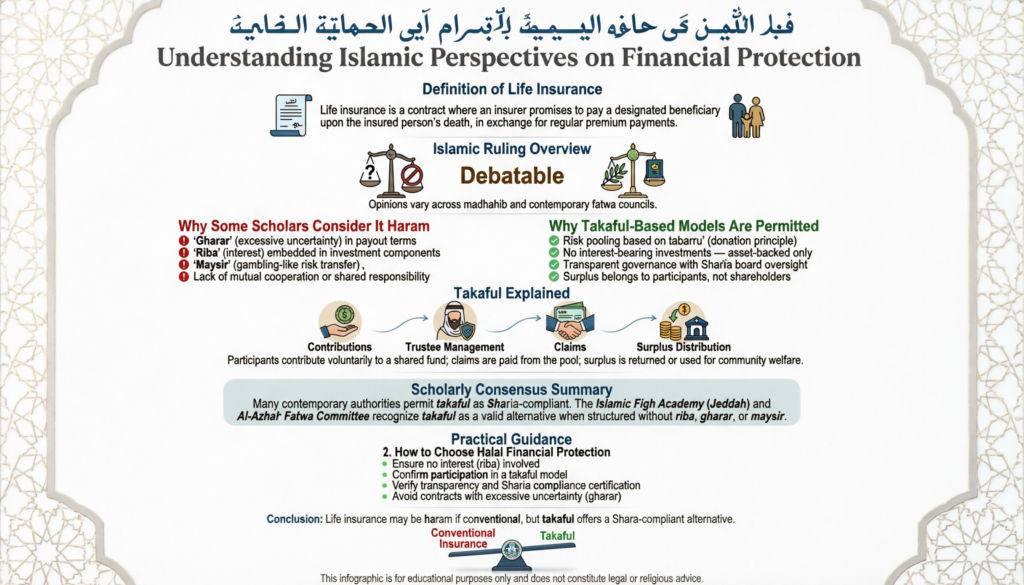
Why Traditional Life Insurance Raises Concerns
Classical objections center on three Islamic finance principles, as explained by Islamic Finance Guru [https://islamicfinanceguru.com/articles/is-life-insurance-haram/]:
| Principle | Issue with Conventional Insurance | Islamic Alternative |
|---|---|---|
| Riba (Interest) | Insurers invest premiums in interest-bearing instruments | Takaful (cooperative) models avoid riba |
| Gharar (Excessive Uncertainty) | Unknown payout timing/amount creates speculative uncertainty | Defined contribution structures reduce ambiguity |
| Maysir (Gambling) | You might pay premiums for years with no “return”; insurer might pay out more than received | Mutual cooperation models replace zero-sum gambling |
The Accounting and Auditing Organization for Islamic Financial Institutions (AAOIFI) standards [https://aaoifi.com/] historically considered conventional insurance prohibited due to these elements. However, scholars increasingly distinguish between commercial insurance and necessity-driven protection.
Scholarly Positions: Three Main Views
Strict Prohibition (Hanafi, some Maliki scholars)
Any fixed-benefit contract with uncertain events constitutes gharar. Is life insurance haram? Yes, unconditionally. Muslims should rely on family support and sadaqah (charitable giving).
Conditional Permissibility (Contemporary fiqh councils)
When no Islamic alternative exists and family faces genuine hardship, conventional insurance becomes permissible under duress (ḍarūra). This mirrors rulings on eating pork when starving.
Full Permissibility with Structure (Islamic finance scholars)
If policies avoid riba-based investments and operate on cooperative principles, is life insurance haram becomes no—it’s transformed into legitimate risk pooling. This view underpins modern takaful products.
Takaful: The Islamic Alternative
When asking is life insurance haram, takaful offers a sharia-compliant path. Unlike conventional insurance (risk transfer to a corporation), takaful operates on:
- Tabarru’ (Donation): Participants contribute to a pooled fund as voluntary charity
- Mudarabah (Partnership): Operators manage funds for profit-sharing, not guaranteed returns
- No riba: Investments screened for sharia compliance
- Surplus distribution: Excess funds return to participants, not shareholders
The Islamic Financial Services Board [https://www.ifsb.org/] reports takaful grew 14% annually through 2024, with products now available in 80+ countries. Major providers include:
- Salaam Halal Insurance (UK)
- Islamic Insurance Company (Jordan)
- Takaful Malaysia
- American Family Takaful (USA)
For Muslims in Western countries, is life insurance haram increasingly has a practical answer: choose takaful where available, conventional only when necessary and with intention to switch.
Bank Owned Life Insurance: What Muslims Should Know
What Is Bank Owned Life Insurance?
Bank owned life insurance (BOLI) is a separate product category with distinct rulings. Here, banks—not individuals—purchase life insurance on employees’ lives. The bank is owner, premium payer, and beneficiary; employees must consent but receive no direct benefit (sometimes split-dollar arrangements provide partial benefits).
As detailed by the OCC [https://www.occ.gov/news-issuances/bulletins/2004/bulletin-2004-56.html], bank owned life insurance serves as tax-advantaged investment vehicles for financial institutions. Banks use BOLI to:
- Fund deferred compensation plans
- Offset employee benefit costs
- Generate tax-free investment income
Islamic Analysis of Bank Owned Life Insurance
Is life insurance haram when banks own the policy? The individual employee perspective differs from corporate structure:
| Scenario | Ruling Consideration |
|---|---|
| Employee required to participate | Coerced involvement in potentially riba-based instruments raises issues |
| Employee receives split-dollar benefits | Personal benefit resembles conventional insurance; scholarly review needed |
| Employee merely consents, no benefit | No direct individual prohibition, but institutional complicity concerns |
| Employee unaware of policy existence | No personal accountability for undisclosed arrangements |
The Fiqh Council of North America [https://www.fiqhcouncil.org/] hasn’t issued specific BOLI guidance, but general principles apply: Muslims should avoid direct benefit from riba-based contracts when alternatives exist.
Real-World Complexity
A 2023 case involved a Muslim software engineer at a major bank who discovered bank owned life insurance coverage on his life without his knowledge. The bank claimed “implied consent” through employment agreements. Islamic scholars consulted ruled:
- He bore no sin for the bank’s unilateral action
- He should formally object to remove himself from the policy
- If the bank refused, continuing employment required balancing necessity against complicity
This illustrates how is life insurance haram questions often require situational fiqh rather than blanket rulings.
Practical Guidance for Muslim Families
When Conventional Insurance May Be Permissible
Contemporary scholars including Sheikh Yusuf Al-Qaradawi (rahimahullah) and the European Council for Fatwa and Research permit conventional insurance when:
- No takaful alternative exists in your region
- Family faces genuine financial vulnerability without coverage
- Intent is protection (ta’min), not investment speculation
- Efforts made to minimize riba exposure (selecting term over whole life, for example)
The IslamQA platform [https://islamqa.info/en/answers/45905/what-is-the-ruling-on-insurance] summarizes: “If a person is forced to take out insurance… there is no sin on him, in sha Allaah.”
Steps to Sharia-Compliant Protection
- Search takaful first: Contact Islamic societies, Muslim financial advisors, or international providers
- Choose term over permanent: Less embedded interest, lower premiums, pure protection intent
- Document necessity: Keep records showing why conventional coverage was required
- Make intention clear: Niyyah (intention) of protection, not profit from uncertainty
- Plan transition: Switch to takaful when markets mature or relocation allows
Bank Owned Life Insurance: Employee Rights
If your employer maintains bank owned life insurance on your life:
- Request disclosure: Federal law requires notification; verify consent forms you signed
- Understand benefits: Some BOLI arrangements include survivor benefits—know your rights
- Assess sharia implications: Consult qualified scholars if you receive split-dollar benefits
- Consider objection: Formal opt-out where possible, documented for your records
The NAIC explains [https://content.naic.org/article/consumer-alert-stranger-owned-life-insurance] that bank owned life insurance differs from STOLI (stranger-owned), which involves investors purchasing policies on unrelated individuals. STOLI raises sharper ethical and legal concerns; BOLI at least requires employment relationships.
Frequently Asked Questions
Is life insurance haram in all circumstances?
No—scholarly opinion varies by school, product structure, and necessity. Takaful (Islamic cooperative insurance) is widely accepted. Conventional insurance may be permitted under duress when no alternative exists and family protection is essential.
Can Muslims work for insurance companies?
Depends on role and product type. Actuarial or administrative work for takaful is clearly permissible. Conventional insurance roles involve more debate; some scholars permit if the majority of work is halal, others discourage any involvement with riba-based contracts.
What about employer-provided life insurance?
Group term life through employment often lacks individual choice. Most scholars permit participation when required, especially if the employee doesn’t control investment of reserves. Opting out when possible and purchasing personal takaful is preferred.
Is bank owned life insurance the same as personal life insurance?
No—BOLI is institutional, with banks as owners/beneficiaries. Employees typically receive no direct benefit (unlike personal coverage). The is life insurance haram question applies differently; employees should ensure no compelled participation in riba-based benefits.
Do I need to cancel existing conventional life insurance?
If you can switch to takaful without coverage gap, scholars encourage it. If cancellation leaves family unprotected, maintain coverage while working toward compliant alternatives. Necessity (ḍarūra) permits temporary continuation.
Are Muslim countries’ insurance companies automatically halal?
Not necessarily—many Muslim-majority countries operate conventional insurance sectors. Look specifically for “takaful” designation and sharia board supervision, not just geographic origin.
What about health and disability insurance?
Similar principles apply, though health insurance often faces less strict rulings due to immediate necessity of medical care. Takaful health products increasingly available; conventional coverage permitted when essential.
How do I find takaful in the United States?
Options remain limited but growing: Salaam Halal Insurance (term life), AIG Takaful (business), and some mutual models. Muslim community organizations often maintain updated provider lists. International takaful may cover expatriates.
Does making insurance claims involve haram income?
No—benefits paid from legitimate premiums for covered losses are your right, not riba. The prohibition concerns contract structure, not claim recovery. However, fraudulent claims constitute illegal deception regardless of contract type.
Should I consult a scholar before purchasing?
Yes—particularly for substantial coverage or complex situations. General guidance cannot replace personalized fatwa considering your madhhab, financial situation, and local alternatives.
The Bottom Line
Is life insurance haram? The honest answer: it depends. Traditional commercial insurance contains elements problematic under classical fiqh. Yet protection of dependents ranks among Islam’s highest priorities, creating legitimate scholarly flexibility.
The path forward combines sincere intention, reasonable effort to find compliant alternatives, and recognition that Islamic finance continues evolving. Takaful grows more accessible yearly; what required conventional coverage yesterday may not tomorrow.
For bank owned life insurance, awareness matters more than anxiety. Understand your employment benefits, assert your rights, and seek guidance if directly benefiting from these arrangements.
Ultimately, Allah judges intentions and efforts. Protect your family through means as clean as circumstances allow, make dua for better alternatives, and trust that sincere striving finds acceptance.
Educational only; consult qualified Islamic scholar for personal rulings. Data as of February 2026.